Wandering in the Wilderness (Without Wisdom)

Camping-gear


I did not ever imagine over the 8 or 9 summers during the 1980’s when a small group of friends and I planned a yearly backpacking trip that I could possibly get lost.  After all, I was hiking with guys with a lot of experience.  Getting lost seemed the least of my worries.  Mosquitoes and having to eat freeze-dried food were much higher on the list of unpleasant realities.

This happened on the first of three attempts we made to get into and spend some time in Evolution Valley, one of the prettiest spots in the backcountry of the Eastern Sierra.  It probably remains so pristine because there is no quick way into it, at least not for guys like us who were not up to 10 mile, full-day hikes and 10-day trips.  But when planning the trip in May we were always much faster and more ambitious than once we strapped on the 50-pound packs in August.

Mount Mendel, Mount Darwin and the Hermit, Evolution Valley, Kings Canyon National Park, Sierra Nevada, California


I officially became trail-stupid on the second day of the trip. We reached a stream that did not have an obvious safe crossing spot and had to stop and scout both up and down stream to find a suitable place. We finally found one upstream, crossed, and then stopped to pull out our rain gear as it began to drizzle steadily. I was a bit slower getting geared up, and Scott and Jan started back downstream to pick up the trail. I assured them I’d catch up in a minute.

I was probably two or three minutes back when I also headed downstream. Somehow, though, as I angled cross-country away from the stream, I missed the trail. Even though we were in fairly flat terrain there were enough hillocks to block my view of the other guys and in the open like that, they could not hear a thing when I called out.

I alternately decided that I was above or below the trail and then would adjust my direction, certain the trail must be just over the next rise. I would stay the course for 10-15 minutes at a time before I’d be forced to stop, survey the landscape and try to figure out “if I was the trail, where would I be?”

Like a man refusing to stop and ask for directions, I would decide on a new angle and plunge off once again, sure that I was just minutes away from the security of the trail. Even as I did it, I knew I was making a fundamental mistake. I refused the one sure way to get back on track, which was to go directly back to the stream and slowly hike up and down the shore until I saw the trail, the smart and sure thing to do. No, it was going to be just over that next hill. Keep moving forward.

As my misdirections continued, panic began to creep in. I mentally checked for how many of the “10 Essentials” of backpacking I had (things like firestarter, emergency blanket, food, etc.) and figured I was at about 50%. Part of backpacking as a group was to split up all of the “common” gear so I had the tent poles, but no tent. I had food, but Jan had the stove, and Scott had the cooking kit. As the hour got later, and the rain continued to fall, I began to think that maybe, just maybe, I would be spending a very cold, wet night exposed and on my own.

And then, as I was staring at my misguided path, I saw hoof prints. On previous trips we had seen, and often cursed, campers being packed in on horses, with guides, good food, and cold beer. We celebrated our manly misery and ruggedness as they passed us while secretly harboring intense jealousy that we hadn’t thought far enough ahead to book one of these trips ourselves.

I knew that these guided trips might go off-trail for a bit, but that they would always return to the trail for greater ease of riding. The path of hoof marks was easy to follow and when it suddenly veered to my right, I looked up and there, like a broad pencil mark traversing the rolling landscape, was my trail.

I had officially been lost for maybe an hour, but it had felt much longer. It was getting into late afternoon, and the steady drizzle had not let up. I knew the guys had probably found a campsite by now, and all I had to do was to keep plodding toward it.

It was funny how once the crisis was over, I quickly forgot about all of the dire circumstances that I had begun to imagine for myself, and the anger at myself for being so foolish and instead became fiercely focused on the keen skills of observation that I had shown and the clever deductions that had saved me.

I owe my friend Scott for many things. He brought me back to the wilderness, taught me so much about backpacking and about how to laugh at myself. We taught at the same high school for over twenty years and then played as hard as we worked. But my most enduring memory will be of that day, as I trudged along, tired and damp and weary. I looked ahead and there he was in his blue rain jacket, smoking a cigarette, and scanning the trail for me. He and Jan had set up camp and soon realized that something had happened to delay me. Scott volunteered to walk back up the trail, tuck himself under a tree, and wait. I was enormously happy to see him.

So as we ate and I told the story on that soggy night, we realized that we had collectively learned an important lesson. We now realized that we must always establish fixed stopping points where, knowing we would get stretched out on the trail because we all walked at different paces, we would meet up and carry on. We’d never again make the mistake of possibly leaving someone behind.

But what I quietly learned was a lesson in self-reliance. I had screwed up. I had fought through the panic. And, most importantly, I had figured it out and gotten back to camp safely.

But I had also learned that I was never truly out there on my own. If I had not been able to find my way, Scott would have been there to find me.

Next up! Scott Gets Abandoned—Or Thinks He Does!


Texting: Proceed With Caution

Text-Fails-11


When I taught a short story elective, I loved using Dorothy Parker’s wickedly satirical story “A Telephone Call.”  It’s a wonderful example of the use of internal monologue as a (more than) slightly obsessed young woman literally waits by the phone, expecting a call from a young man that she is apparently dating.  Published around 1930, I had to build some context for the students.  Yes, phones used to have dials. Yes, women used to wait for men to call first.  At the time, it was considered forward and inappropriate for a woman to be perceived as the aggressor—to take the initiative in a relationship.  They honestly looked at me as if I had somehow slipped into a foreign language.

The young woman in the story dramatically ponders every encounter she has had with the man and every word he has said to her previously as she tries to convince herself that the man’s tardy phone call is no reason for alarm:

This is the last time I’ll look at the clock. I will not look at it again. It’s ten minutes past seven. He said he would telephone at five o’clock. “I’ll call you at five, darling.” I think that’s where he said “darling.” I’m almost sure he said it there. I know he called me “darling” twice, and the other time was when he said good-by. “Good-by, darling.” He was busy, and he can’t say much in the office, but he called me “darling” twice.

Upon finishing the reading, the class was quick to claim that she was simply crazy, obsessed, ridiculous.

“Wait a minute,” I said. “Do you mean to tell me that you’ve never gotten a note, or a message, or a text and spent considerable time reading and re-reading it, trying to guess at exactly what the person’s intent and tone was?”

“Ooooh, yeah,” they laughed.  Virtually all of them had stories of messages about which they had obsessed–the more important the person, the greater the examination and analysis.

I am not immune from this. However, my first experience was when my bride-to-be and I dated long distance for two years during the early 1970’s.  We depended on the U.S. mail almost exclusively, writing each other two or three letters a week.  For me, each trip to the mailbox was full of sweet anticipation.  How would she have responded to my most recent verbal advances?  Would there be some vague promise of greater intimacy that would keep me entirely on edge until I could see her over the weekend?  Exactly how would she sign it?  Was “thinking of you” better than “love you” or a generic “see you this weekend” or the ambiguous “luv ya!” ( I mean, really, what does that mean?).

I saved most of these letters and occasionally I’ll grab one, in part to examine the artifact of the 7¢ stamp, but more to enjoy suddenly being cast back 40 years into my past, swept up by the youthful enthusiasm of a first love, feeling caressed by the warm words of affection that have lost none of their impact over the years.

I don’t bemoan the advances in technology or long for the time when one had to wait days for a loved one to receive a letter or to get a response, but I have discovered great dangers in the instantaneosity (I just made up that word) of our communication.

Lots of people struggle with this transition.  I remember when phone message machines first gained popularity and almost every message I got began with “Oh, gosh, I just hate talking to these machines!”  At least for me, that changed pretty quickly to feeling disturbed and a little betrayed when a person actually answered his phone when all I wanted to do was to leave a quick message and wasn’t mentally prepared for all the social niceties that go along with an entire phone call.

Texting has taken this dynamic to a whole new level.  In talking with my former students, especially those involved in some kind of romantic relationship, texting seems to be the primary means of communication, possibly exceeding face-to-face conversation.  When they have described their day or even week-long texted “conversations” to me, I become convinced that they have thrust themselves into starring roles in a Dorothy Parker short story.

I get a lot of questions from former students, mostly young women who are now friends, particularly if relationships come up as an issue.  If they are in the midst of some intense texting with their intended, I get asked to help interpret–“after all, you used to be a guy.”  Yes, once, long ago.

“I mean, what does it mean when he says he loves me, but he needs some time, some space?  (“Means he’s dumping you”) “ How can he say he loves me and then just treat me like crap!” (He’s cheating on you) “But he texted me at 2 AM and it really sounds like he means it this time.” (No, it means the bars just closed, he’s drunk, and feeling nostalgic, not romantic).  “How long should I wait before I respond?”  (“For. Ever.”)

 In truth, I never say any of the things above that are in parenthesis.  In truth, I have no idea how they should respond and what they should do.  Mostly I just listen and try to figure out what they are hoping that I will say, and reassure them that yes, eventually, everything will be just fine.

Texting has been problematic for me also.  I have found that sarcasm does not translate well in texting, so I have had to resort to an occasional 🙂 to let the person know I’m teasing and not savaging them with some off-hand remark.  However, most emoticons are a mystery to me and I don’t use them because they seem silly and confusing.

But the greatest danger I have found in texting is not in being misunderstood.  After all, you can always go the extra mile and actually talk to the person. No, far more dangerous is texting under the influence.  Because, let’s face it, we often use words to shield ourselves from the raw emotions we might feel in the moment.  Take away that filter, that safeguard, with two or five beers, and anything might happen.

Recently, I flew from San Diego to Phoenix to see the great James Taylor in concert, a concert I had been waiting to see for 40 years.  Lucking into ninth-row seats and getting close enough at intermission to have him autograph my ticket, left me walking back to the hotel full of the afterglow of a night I had waited for for a very long time.  I was exhausted, but just didn’t want the night to end.  Have you ever felt that way?

I ducked into the hotel bar around midnight, hoping to slip in before last call.  Well, it turns out that “last call” was a pretty flexible concept to the bartender, and I was content to have a beer, watch basketball highlights, and eavesdrop on a blonde sitting nearby who was spewing profane and angry invective about her ex-husband and life in general to an anxious looking guy who I think was listening patiently and hoping to get lucky.

Pretty soon, those two cleared out (the guy never actually had a chance it turned out), and it was just me and Brian, the bartender.  One beer turned into three and then after a bit, my glass just kept getting refilled without me even asking.  I figured out later that once Brian and I had hit it off, he simply wanted someone to talk to while he got the bar closed up sometime around 2 AM.

I suppose that it’s not universally true, but it seems that anytime after 2 AM, alone in a hotel room, is about the loneliest place I have ever found myself.  I would be home in less that 12 hours, slightly hung over, but surrounded again by all things familiar, but somehow the need to reach out and make contact with a friend right then and share something about the wonderful concert, the too-long stay at the bar, my guilt over realizing that I should know better, seemed overwhelming.  I composed a text about the night that I had just spent but feared sending it to anyone.  My sister in Maui and my wife in San Diego were sound asleep, and I knew I could not disturb either of them.  In the end, I picked on a friend, a teacher in New York City, someone who I convinced myself just might be awake, someone who I knew would forgive an ill-timed text.  I was surprised to get a quick response, somewhat garbled although she claimed to be awake already, reassuring me that if I drank some water, took some Advil, and went to bed, I’d be just fine in the morning. She was right of course, and I did just that.  Eight hours later sitting at the airport, I wrote her a much more sober apology text, an I’m-such-an-idiot text, which she laughed off forgivingly.

Texting, like every use of language, is imprecise and subject to misinterpretation.  It can create confusion, anxiety, heartache and is the worst tool to be used for a break up since the post-it (“I’m sorry, I can’t, Don’t hate me”).  However it is an extraordinary advancement in aiding the most human of needs—the need to stay connected; to reach out to a friend on a lonely night; to share a picture with your son; to make your daughter laugh; to remind your wife that you haven’t forgotten the days of the 7¢ stamp.


I Don’t Hate Poetry

poetry

I really don’t.  But I don’t love it either.

As a retired English teacher this is practically heretical.  Through most of my 36 years of teaching, I used poetry sparingly, but during the last 10, when I began teaching Advanced Placement English for seniors, it needed to become a central part of my curriculum in order to prepare kids for the AP Literature and Composition Exam.

Early on, I went to every AP Lit workshop I could find and tried to glean an approach, a unit, a set list of poems or literary terms that would lead me to a greater comfort level, and I discovered many wonderful plans created by lit teachers much smarter than me.  But none of them were a fit for me and my understanding of how 17-year-olds think.  Some of the literary terms were so obscure that even if I could force a kid to memorize the definitions, the chances of the student actually recognizing the technique or being able to comment on its relevance seemed iffy at best.  When it came to teaching meter (the metric rhythm of a poem), which some of my colleagues would spend hours on with great relish, I was a total failure.  Beyond iambic pentameter, I couldn’t recognize a line that was trochaic, spondaic, or anapestic if you held a gun to my head.

So, I shortened and simplified my list of lit terms, focusing on ones that kids could actually remember and that seemed most often applicable to the kinds of poems that showed up on the test.  I abandoned meter entirely with nary a feeling of guilt, and I created Poetry Day.

I decided that I needed to provide opportunities for kids to sit together, look at dozens of poems, struggle through them, and come to some kind of meaning. I wanted them to become a poetry salon, one day a week, and to begin to look to each other for understanding with as little help from me as possible.

Poetry Day was a risk for me, and I firmly expected it to be a failure. My idea was that once a week, four students would sign up ahead of time and be tasked with the responsibility of choosing a poem from our anthology for discussion. The class would form a circle and each of the chosen students would be the discussion leader for the poem that he or she had selected.  My role (I hoped) would simply be to sit in back and keep track of participation and try to keep my mouth shut.

The discussion leaders’ job was simply to read the poem, maybe take a minute to tell why they had chosen it, and then direct the traffic of the hoped-for participation that would then follow.  The shock to me was that the participation came.   The kids seemed to like the new approach–the freedom to explore, no teacher to tell them the “right” answer, how the more they looked at the poem, the more that they began to see.  What excited me the most was seeing how the students would throw out an assertion, listen to the response of their classmates, and then reconsider and revise their thinking. On an exceptional day, I might say nothing more during the entire hour than, “Good job.  Let’s move on to the next poem.” Those days felt like great successes to me.  I had created an opportunity where kids were learning, questioning, thinking, cooperating with the gentlest bit of direction from me.  Those days felt like good teaching.

Not every Poetry Day went that well.  The ebb and flow of the semester, the ebb and flow student enthusiasm, the absence of caffeine, the approach of more important things like prom, all made for good and bad days.  My role evolved also.  I found that it helped to ask clarifying questions and force students to refine their thinking when they were oh-so-close to a gem of an idea, but might be missing a critical element.  Then there were the times when, despite their best efforts, they simply missed the meaning entirely, and I’d have to force them, as a class, to go back to the poem, look more closely, think again.  We jokingly established a part of the classroom that we labeled as “left field” where we figuratively sent students whose interpretations had flown so far off track that I had to call them on it.  In fact, it became part of our lexicon.  Students would sometimes begin their explanation of a difficult passage with, “This may be out in left field, but I think…”  I absolutely loved them for that.

My most memorable Poetry Day moment came when one of my student’s had chosen Deborah Pope’s agonizingly painful and beautiful poem, “Getting Through.”

Like a car stuck in gear,

a chicken too stupid to tell

its head is gone,

or sound ratcheting on

long after the film

has jumped the reel,

or a phone

ringing and ringing

in the house they have all

moved away from,

through rooms where dust

is a deepening skin,

and the locks unneeded,

so I go on loving you,

my heart blundering on,

a muscle spilling out

what is no longer wanted

and my words hurtling past,

like a train off its track

toward a boarded-up station,

closed for years,

like some last speaker

of a beautiful language

no one else can hear.

I remember the discussion leader reading the poem aloud and nearly 40 kids staring at the text with no idea of what to say.  I suggested the leader read it aloud once more, which we did quite often when confronted with a challenging poem.

The silence continued until suddenly Sarah, a thoughtful and sensitive young woman, gasped as she internalized the sadness and the pain of the poem.  In that one moment, she had grasped the whole poem with it’s string of vivid similes, each becoming more detailed, that described the speaker’s devastating sense of loss and hopelessness.  Once she gave the class the key, the images suddenly made sense, and the class piled on with an appreciation of the beauty of the language and the universality of the experience of loss.

I truly loved poetry on that particular day.  Sarah’s gasp, her identification with the pain of the speaker, spoke to everything that I find to be important about poetry.  The poet that can distill the human experience, can craft the perfect metaphor, provides a human connection that helps us to defy loneliness and isolation.  They are magicians. They create the connection that tells us that, even in our worst moments, we are not alone.

Oh, the Bitter Pill of Irony

Unknown-1

So, it ends up that four hours after I posted my previous piece on the pitfalls of hypochondria, I ended up in the emergency room with chest pains.  It was the perfect storm of chest tightness, occasional pain, a raised level of blood pressure, with a touch of vertigo thrown in that pushed me to my 6% threshold of uncertainty and led me to ignore my own certain wisdom and call the Kaiser “advice nurse.”

Once I got on the line with her, she prepared me for the 150 questions she was about to ask me, but I already knew there was only one that was important:  “Are you experiencing chest pain?”  The rest of the questions were all relevant but unrelated to my immediate future.  I was going to the emergency room.

9 PM on the Tuesday night after the Memorial Day weekend and it was SRO in Kaiser emergency, and a lot of these people looked profoundly uncomfortable.  In fact, just being around them made me feel more sick than when I had come in. “Chest pain” used to get you right in the door and into a room, but once they established I was stable, I was sent back out to the waiting area.  In fact, I half expected one of the nurses to come out and look at my chart and yell at me, “Your pain level is a 2?!  You call that pain?!  I’ll show you pain, mister!!  Man up and come back when it actually hurts!”

Sitting, watching the waiting room slowly empty out until almost midnight began to re-define the entire concept of an “emergency” for me.  Once, my name was finally called, I was ushered into a very nice, private observation room where the hospital protocols kicked in and in short order blood was drawn, my chest was x-rayed, and a series of nurses and doctors stopped by to ask me the same, exact questions, over and over again.

It took until 4 AM for them to decide that I was going to spend the night, although that ship had clearly already passed, and that I was going to stay with them until I got a cardiac stress-echocardiogram done, hopefully in the morning.

Somehow the word “hopefully” got past me.  My weary and long-suffering wife left me to go home, and I passed out, finding it easy to follow their orders to not eat or drink anything before it was time for the test.  By mid-afternoon, when they decided they could starve me no longer, they broke the bad news that there were no openings for the procedure and I would have to be admitted to the hospital to spend yet another night eating hospital food and watching re-runs of Law and Order SVU.

Around 9:30 PM a bed finally opened up in the hospital, and I was transferred out of my fairly comfortable private digs to a regular room, a room that came complete with a roommate.  After ten minutes in the room with him, I became convinced that the only reason the bed had become available was that the previous occupant had begged to be removed, offering to sleep in a closet or to be taken off life support—anything to get away from this guy.  A nurse came in to ask me my list of questions again and then threw in a new one.  “Do you ever have thoughts of harming yourself?” she asked.  “Not until just recently,” I deadpanned.

He was in pretty bad shape and hard of hearing so the nurses had to repeat everything they told him, loudly, and he talked loudly in return.  And he loved to talk.  Every nurse’s visit prompted a new story about his wretched physical condition or his adventurous life.  He had been a musician his whole life and owned hundreds of musical instruments, had traveled the world, and spoke lovingly of his wife. He veered horribly close to insulting both a Hispanic and Pilipino nurse and somehow managed to re-engage them, turn on the charm, and became nothing but grateful for their help.

I was almost starting to like him somewhere around 11:30 PM when he suddenly began trying to cough up a lung.  He hacked and spat and swore and then started all over again.  In deference to me, he went into the bathroom to hock up the other lung, but it was impossible.  I could hear everything.  I decided to give up on sleep for the night as he settled in to watch some late-night TV which turned out to be the perfect tonic. Before I knew it, I was sound asleep.

The new day brought an introduction to new modern miracles of medicine.  By 7:30 AM I was being whisked away for a 4-hour chemical stress echocardiogram.  This involves having pictures of your heart taken at rest to create a baseline and then injecting you with chemicals which stress your heart so they can take more pictures to see if your heart is functioning efficiently.  It seemed somewhat counterintuitive to me to mess with such chemicals, but since I was not feeling the whole treadmill thing, I went for the drugs.

When I was ready for them, I was taken into a room with a treadmill and lots of monitoring equipment.  I was told that I was going to get a “lexi-walk” which was a combination of actually getting me started on the treadmill and then administering the drugs that would give me the jolt.  I started my stroll on the treadmill, but couldn’t get the term “lexi-walk” out of my head.  I’m sure it was my sleep-deprived state, but it kept conjuring two competing images in my brain.  In one, I was strolling down the beach with an adoring young thing named Lexi on my arm, and in the other I was being forced to walk someone’s annoying poodle, whose full name was actually Alexandrika.  The images faded quickly when the nurse pumped two injections into my IV and suddenly I felt like I was running a marathon–badly.

After more pictures, it was back to the room.  My roommie had vacated temporarily, and my nurse was kind enough to have the nutritionist come in and let me make a special order for my lunch.  Oooh, the salmon sounds good and of course I want the mashed potatoes and gravy, and broccoli–not those nasty canned green beans from the night before.  How nice, I thought.  Personalized service! Peace and quiet!

Within the hour, my lunch arrived:  chicken, undercooked carrots, and a bread roll made from sawdust (gluten free, I’m sure).

The only thing remaining, besides getting over my disappointment over lunch, was the visit from a doctor to tell me the results.  He was effusive.  “A model heart!  Your heart sets the gold standard for how we’d like these tests to come out!  Yeah, we have no idea what was causing your pain or discomfort, but you seem to be feeling better, so you are good to go!!”

40 hours.  40 hours to hear that despite all of the symptoms and a bucket load of worry, I was just fine.  Better than fine.  A model that other 61-year-olds should aspire to.  It almost made me wish that nurse had come out and yelled at me 40 hours earlier.  “Call that pain?!  You come in hear and bother us with a level 2 pain complaint?!  You don’t know the meaning of pain!  You ain’t even coughin’ up a lung like that poor old guy in 5011B.  Now, that’s an emergency!”


“So, Hypochondriacally Speaking…”

i-told-you-i-was-sick-tombstone

I’m not a hypochondriac.  At least, I don’t think so.

But at 61, I have several chronic conditions (TMJ, upper neck and back pain, anxiety) and then other issues that make guest appearances from time to time (vertigo, extra heart beats, random muscle pain and spasms). I go to the doctor if something seems unusual, or if I suspect they might have some treatment that will improve the chronic ones but other than that, I just try to enjoy the fact that basically, I’m pretty healthy.

However, if several of these symptoms show up at the same time, say vertigo, a restless heart, and a little chest tension, then, of course, my anxiety shoots up and I start getting worried—which makes everything worse.

I’ve had enough false alarms that I’m wary of rushing off too quickly to the doc. I have learned not to call the Kaiser “advise nurse” because no matter how benignly I might describe my symptoms, her solution is always to send me to emergency room hell. I also NEVER Google a symptom. There is no quicker way to be sure that you are dying of some heinous disease, than to plug in a couple of symptoms and let a multitude of websites guess at what you might have.

Because the neck pain drives me crazy, I take ibuprophen every day. I’m confident (because I’ve read the warnings on the side of the extra-large bottle) that eventually my stomach will explode because of it. So when I started to develop a chronic pain on the right side of my abdominal area, I decided to go in to see my doctor. I explained my concerns about the ibuprophen destroying my stomach, and he told me straight out that that was not the issue since my stomach is on the left side. The right side contains the pancreas, liver, and spleen. Great, I thought, now I’ve got three critical organs to worry about.

After reviewing my blood work and doing a physical exam, he told me that he was pretty sure I had something called “abdominal wall pain” which sounded like something that doctors say when they have absolutely no idea what is wrong with you. He reassured me that he had eliminated 95% of the “really bad stuff” and that this diagnosis really did make the most sense. To eliminate the other 5%, he could order up an MRI and blast me with lots of radiation. I decided that I was OK with 95%.

During the exam, though, he introduced me to an interesting bit of doc-speak. He told me that he understood my concerns and my desire for him to be thorough, and that every doctor has to evaluate his patient’s “tolerance for uncertainty” in making a diagnosis. I now know that my “tolerance for uncertainty” is 5% or lower. If I’m 6% uncertain, I’m going to want to full monty of tests, radiation be damned.

However, my tolerance was sorely tested on Christmas Eve this past year. After our usual wonderful meal and as the family celebration was continuing, I excused myself to go to the restroom. Imagine my surprise when I discovered my urine had turned pink. Blood in the urine! This can’t be good. Either my stomach had finally exploded or something was surely wrong with my pancreas, liver, and spleen now that I knew for sure where they were.

I could not rush off to the emergency room on Christmas Eve even if it meant having my kids watch their dad slowly bleed out as we drank beer and watched “A Christmas Story.” I calmly told my wife, and she agreed that I should monitor the situation and as long as I wasn’t in pain, we could get it checked out later. By noon the next day, the symptoms were gone and all that was left was that nagging worry that at any moment, I could go critical again.

I waited until December 26th to go in to see an urgent care doctor and recounted the series of events and my various theories, all of which he kindly discounted. In fact, he seemed intent on assuring me that he was in far worse shape than I appeared to be. He asked me a long series of questions, none of which led to a conclusion. Finally, he paused and asked, “Did you eat anything unusual?”

Beets. Mary had made a beet salad from fresh beets and I ate it to be polite and because I read somewhere that purple food is good for you. I don’t even like beets. No one had ever told me that fresh beets, eaten in large enough quantity, will color everything that passes through your body for about 8-12 hours. Sure, ibuprophen has warning labels, but not beets.

So, am I a worrier—yes. Possessor of a 5% tolerance for uncertainty level—absolutely. Anatomically ignorant—check. Hypochondriac?—Hmmm. Still not sure. I think I’ll wait until the next time I’m nearly killed by a vegetable to decide.


Grieving in Teaspoons

momdad

When it comes to grief, I often feel there is something I am missing.

I watch my friends and relatives deal with the loss of a loved one and often they are drenched in sorrow, tears, depression, and anger. I just passed the sixth anniversary of the death of my dad, and I have lost some friends and colleagues about whom I cared deeply. In fact, as I enter my 60’s, I find myself attending too many funerals as social events. However, in watching the grieving of others, I have been surprised (so far) by my own sense of detachment, as if I’m failing at grief.

My dad, Jack, was a wonderful man. He gifted me with his sense of humor, an indispensible tool in my experience as a teacher, and he lived his 86 years with a sort of joyful kindness and a true affection for others, especially his grandchildren. When we gathered for his funeral, the same comments came up over and over. No one could remember ever seeing him angry. No one could remember him uttering an unkind word toward another person.

As a child, he came to know the things I cared about and made sure I got to experience them. He was never a sports guy, but he could see my interest grow. So he made sure I got to see the Dodgers in Chavez Ravine (unfortunately a guy named Joe Moeller was pitching that day instead of the great Don Drysdale or even greater Sandy Koufax). We made regular trips to Westgate Park where the minor league Padres played their games. We experienced hockey, professional basketball, and the Harlem Globetrotters together. When Bill Cosby broke on the scene, and I began to memorize his comedy routines and perform them at Scouting events, he surprised me with tickets to see him live on stage. I am positive he would never have spent that money on himself just for his own enjoyment.

My dad’s last three years were difficult ones. He became increasingly crippled by arthritis and was in constant pain. Dementia began creeping in. He kept punctuating conversations with phrases like, “I bet you never thought you’d see your old dad all crippled up like this” as I’d help him into the car on the way to endless doctor appointments. More and more often, even at holiday gatherings, he began to express his desire for his life to be done with. Hearing every one of those woeful comments was a moment of grief for me.

He passed away in the hospital, sneaking away suddenly and quietly. He woke up in the morning, began teasing the nurses and talked one of the pretty ones into helping him with his morning coffee. He got on the phone to my mom to find out when she was coming in to see him and took time to tell her once again how much he loved her. And then, when no one was looking, he died. It was May 2, 2008.

I expected to have a wrenching, emotional response even though he had been through three years of suffering, and we had had numerous close calls during that time. Instead, I found myself consumed with the details of his funeral, keeping an eye on my mother and my children, and in writing a eulogy that would give him all the credit he deserved.

That emotional response never came for me, not entirely. My good friend Stephen noticed it and told me, “You can’t just be the tough guy through all of this. You have to allow yourself time to feel it.” But it just wasn’t there. Not then.

The first time it hit me was in June. I was on a walk through the neighborhood and mentally working on a “to do” list, and it hit me that it was almost Father’s Day and that I needed to be sure to get by the store and pick up a card for……oh, yeah. I didn’t need to do that. I would never need to buy a Father’s Day card again. Suddenly, his loss began to feel real.

In September, I was chosen as one of five San Diego County Teachers of the Year, a truly memorable recognition, at a televised, gala event at the Balboa Theater in San Diego. In accepting the award, my thoughts went right to him and how proud he would have been to see me receive that award. He was never the kind of father that I had to work to impress or please, but someone who always gave me the confidence that came with knowing that my father believed that I had already exceeded every expectation that he could ever have for me. I missed him there, on that stage that night.

One of the most trivial, but most painful moments came when I grew tired of seeing “Mom and Dad” on my cell phone every time I had to call my mom. It was inaccurate. Dad was gone. Dad was not going to answer.   I needed to delete my father. Every press that removed the “and Dad” felt like a rejection and a betrayal.

Even today, I will catch myself thinking of an odd encounter or a pleasant moment and how I need to get on the phone and call my dad and tell him the story. And then I catch myself in mid-thought and lose him once again.

I began to realize, early in the process of writing this, that not only does everyone grieve differently, but that my reactions to grief are packaged all around the history and circumstances of the loss. There are potential losses that I refuse to even think about much less write about. I can’t begin to imagine how crushing they might be.

For now, in my way, I still grieve for my dad. This grief continues to be doled out to me in teaspoons, painful ones. Perhaps the next one will be a tidal wave.

dadmarkerII


“Dish Bitch”

Image

This started way back.  Way back when apparently our dishwasher began to emit nearly lethal amounts of radioactivity.  I was the only member of our family unaware of it, and apparently the only one immune from it.

We all liked having a dishwasher.  We would have felt deprived with out one.  No one minded putting dishes into it, and I think there was a kind of satisfaction to be the one who would declare, “I think it’s time to run the dishwasher!”  No one, except me, seemed to understand that the appliance became essentially useless once it was sitting there full of clean dishes.

However no one, and I mean no one, would voluntarily empty the dishwasher. Except me.

I accept the idea that there are certain things that are “dad” jobs.  I understand the division of labor.  I knew that I maintained the outside of the house, and that it was my role to fix things (or make them worse at my discretion), to build walls, and dig up pipes.  As a modern guy, I didn’t mind splitting the household chores as well, and the whole family agreed that we were all better off with me not being the head cook.  For some reason though, bags of trash never made it farther than the middle of the garage, as if my two kids and my wife were incapable of the 7 extra steps it would take to go through the garage door and actually deposit them in a trash can.

And there was emptying the dishwasher.

On a Friday afternoon when my teaching friends were gathered at the local pub, celebrating the end of the week with a few beers, I launched into my lament, the unfairness of it all.  Stephanie, ever able to turn the phrase declared, “Oh honey, you’re just the dish bitch.”  Along with everybody else, I burst out laughing at the label.  “Damn,” I said, “you’re right!  I am the dish bitch.”

I went home determined to ditch my new-found title.  At this time the kids were still in their teens, and therefore basically indentured servants.  Chores around kitchen clean-up seemed to be split between “washing” and “drying” only.  Everyone was long gone by the time the dishwasher shut itself off.  It just so happened that we filled it that night and as I fired it up, I declared “Just so you know, when this gets done, I am not going to empty it.”

The kids (and my wife, I think) rolled their eyes, saying silently to each other, “Ah, dad’s having a thing” and went about their business.  The dishwasher sat full, the dishes cleaned, for another two days.  After all, we had other dishes.  If someone had a favorite glass, you could always pull it out.  Eventually, once I had reiterated my stand loudly and repeatedly enough, the kids broke down and split up the task.

And then things went right back to normal.  Every now and then, I’d try the silent, passive-aggressive approach.  After a week or so, the kids might notice.  “Oh, “ my son would say, “gone on strike with the dishwasher again, dad?” and then he would do the responsible thing.  He’d figure out a way to manipulate his sister into doing it.

Now the kids are grown, and it is just my wife and I and the appliance.  For some reason, she takes great care in making sure the dishes are positioned properly, frequently reorganizing them once I have put them in and occasionally pulling some things out and informing me that “these don’t go in the dishwasher!” although the rules about this always seem to be changing.

I knew I had finally lost the war when I returned from a 10-day visit to my sister in Hawaii and in the morning began to clean up my breakfast dishes and put them in the dishwasher.  “Hey,” she said, “the stuff in the dishwasher is clean.  I ran it right after you left.”

I was speechless.   She was busy getting ready for work, and said it so matter-of-factly that I checked myself from saying what seemed so obvious to me.  In fact, to save time, I just ran the dialogue through my head.

Me:  So, you ran the dishwasher and let clean dishes sit in the dishwasher for 9 days until I would return to empty it?

Her:  Look, when you’re gone, I barely cook, I use paper plates. I never needed anything from it.  I don’t even think about it.

Me:  (long silence, since I have no idea how to respond—this happens a lot)

 Game, set, match.  After all, what if Mary insisted we split up the cooking responsibilities 50/50?  She is nearly a professional chef, and I get confused when the recipe says words like “bake for 30 minutes”.  We would live in a culinary wasteland for half of each week.

So now, I embrace my inner dish bitch.  I am one with the dishwasher. I will make sure that it is cared for and well tended, like my vegetable garden.  Putting away the dishes will no longer be a chore, but my spiritual communion with the kitchen gods.  I will hear Rodney Yee’s voice coaching me as he does in my yoga videos. “Feel your sidebody stretch as both arms extend to put the big plates on the second shelf. Breathe…”

“Just the Facts, Ma’am”–The Top 5 TV Detectives

Image

I was brainstorming writing topics with the family, when I told them I wanted to do a “Top 5” list of television detectives, a genre that I love.  The questions and debating began immediately.  “Well, how far are you going to go back?” asked Greg who has recently become fan of Jack Webb and Dragnet, watching that 1950’s show on Netflix.  Pretty soon we were all immersed in a challenge just to pick out the top 5 Dick Wolf characters from the Law and Order franchise.  Just for background, I skimmed a few “Top TV Detective” lists that I Googled and discovered passionate devotion to shows and characters that I had never even heard of.

So, my blog, my rules.  I decided to stick with shows that are reasonably current and with which I am familiar.  I decided that there would be no attempt at gender balance, so my apologies to SVU’s Olivia Benson, The Killing’s Sarah Linden, and Prime Suspect’s Jane Timoney, all tough, wonderful characters.

That does not mean that I did not establish some criteria.  All of my chosen detectives have some or all of the following characteristics.  I am a sucker for redemption tales, so I’m drawn toward wounded, tortured souls who are often edgy and unafraid of violence.  I like non-conformists whose quirkiness makes them endearing and who frequently frustrate the more straight-laced “suits” around them.  I favor characters who are driven, often by their own demons, to pursue a case that others might give up on and who have that inherent knack of knowing when an investigation is going in the wrong direction and who will doggedly pursue their instincts even when no one else may believe in them.

So, in reverse order we have:

Image

5.  Stephen Holder (The Killing)

For me and the three other fans who got hooked on AMC’s The Killing, the character Stephen Holder is worth every excruciating minute of some of the flawed elements of the show.

There are times where this show becomes maddeningly distracted by it’s multiple story lines and psychodramas, but the story is anchored by Holder (played by Joel Kinnaman) and his partner Sarah Linden (Mireille Enos) and their developing relationship.  Holder is a recovering drug addict, a tall gangly white guy who talks, at times, as if he thinks he is black.  However, his street sensibility and ability to relate to everyday people shows a sensitivity, and at times vulnerability, that is almost entirely absent in his partner’s character. In season 3 he gains entrance to the hangout of a hellish street gang by knowing their slang and despite their taunts, calmly approaches and dominates the gang’s hysterical pet pit bull, giving him a chance to try to glean some information from the thugs.

What makes Holder most endearing are his goofy one-liners and his use of language and metaphor.  He tells Sarah in one scene, “Think of me as your sensei in the bloodsport of life.” Even in the context of the scene, I’m not sure what that means.  Near the end of a scene in a hospital ward, an old man in a ratty robe pushing his way down the dingy hallway in a wheel chair, oxygen tank and all, approaches Holder who greets him with, “Yo, ancient player, got a smoke?”  To the delight of the viewer, the old man pulls out a pack and offers it to Holder. “Don’t mind if I do, thank you sir,” Holder says as he extracts one from the pack.  The old man rolls on down the hallway.

Holder also shows off flashes of insight as he stares at the board full of pictures of missing girls, victims of season 3’s serial killer.  He suddenly realizes that he and Linden are getting nowhere studying victimology, but should be trying to get into the head of the killer.  He blurts out to Linden, “See we been goin’ all Copernicus on this bitch (the case), when we should be Galileo; you feel me?  He gets nothing but a skeptical stare from Linden (“What’s wrong with your face, Linden.  Don’t stroke out on me.”), but explains that they need to become more like Galileo, adopt a more global perspective.  “It’s not about what these girls see; It’s about what he (the killer) sees.”

You won’t see Holder chasing down a bad guy, or flashing a gun, or engaging in a car chase on a weekly basis.  He’s a cerebral guy whose scars, humanity, and ability to turn a phrase push him into my top 5.  Word is that AMC has dropped The Killing, but that Netflix has picked it up and will produce a season 4.

Richard-Belzer-SVU-315

4.  Detective John Munch (Law and Order SVU)

Watching re-runs of SVU remains a guilty pleasure for me especially when I come across an older episode that somehow slipped past me.  However, even when I reach the point in an episode where I remember clearly what the outcome will be, I still enjoy the twists and turns and the fine ensemble cast.

I have to admit, though, that I dropped out of watching new episodes a few seasons ago.  The show lost too many critical characters, particularly Stabler (Christopher Meloni), and the cases got creepier.  So in reading up on Munch, it was news to me that he had “retired” and left the show.  I think I can hear the sucking sound of a very good series going down the drain.

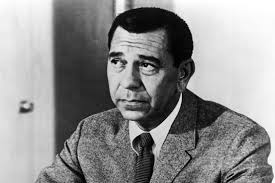
Richard Belzer’s Munch, is a grouchy, cynical detective who entertains the rest of the department with his rants against authority and bureaucracy and his encyclopedic knowledge of conspiracy theories.  He created the character originally for the show Homicide: Life on the Streets (set in Baltimore) in 1993 and then made his way over to SVU as the same character in 1999. According to Wikipedia, “Munch has become the only fictional character, played by a single actor, to appear on 10 different television shows” including shows as disparate as 30 Rock, Arrested Development, and The X-Files.

Like Holder (The Killing), Munch provides contrast with his partners in part because of his crusty personality, but also because he is an intellectual who will frequently reference philosophy, history, literature and art, mostly to the quizzical stares of his partners or antagonists.  In one episode, faced by a government official who refuses to give him information related to an investigation, patiently explaining repeatedly that what Munch wants is “classified”, Munch finally yells at him, “What are the odds you have a picture of Joseph McCarthy tattooed to your ass!”

Munch has the world-weariness that I see in a lot of detective characters, but it’s not just that he has seen too much, but rather that he has a Sisyphus-like nature; while his efforts will never stem the tide of crime and abuse, he has to try.  He knows he is uniquely suited to the task so he continues to try to succeed in a broken system, working to solve the case in front of him, knowing that the cases will never end.  One senses an abiding sadness in him although we know little about his background. Sometimes the sadness flares into fury as it does in a famous scene where he rails against a judge that he views as being too soft on a man they have arrested, gets slapped with a hefty fine, gets declared that he is in contempt of the court, assures the judge that he does have contempt for his court, and ends up in jail.

Well, Detective Munch, I’m sorry to hear you have retired.  I will miss you. You certainly have earned a spot in the Law and Order Hall of Fame.  Maybe you’ll finally have time to nail down just who it was on the grassy knoll in Dallas in 1963.

55-11742-true_detective_matthew_mcconaughey-1389384700 680x478

#3  Rust Cohle (True Detective)

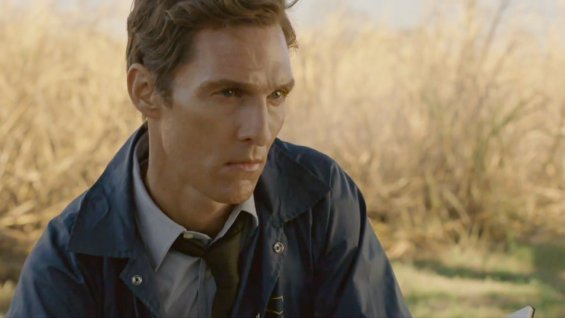
I was pretty much hooked by this series from the moment I saw the opening montage of dark and moody images backed by the dusty, mournful lyrics of the Handsome Family’s song “Far From Any Road.”  The setting is in Louisiana in 2012 but the fractured timeline challenges the viewer to constantly pay attention to where the storyteller is in the narrative which stretches back to the original, haunting case in 1995 and even further back into Cohle’s (played brilliantly by Matthew McConaughey) tragic past.

Cohle just happens to fit every criterion I set out in the beginning.  He is tortured by the memory of a marriage and a child that he has lost and then by his descent into a long stint as a deep undercover agent, an experience that eventually lands him in a mental hospital wracked by drug abuse, PTSD, and insomnia.  He rebuilds his life as a homicide detective teamed with Marty Hart (Woody Harrelson).

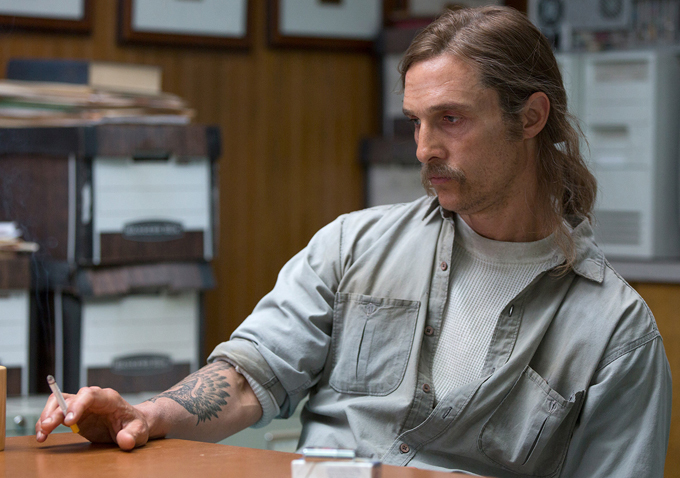
McConaughey’s dual portrayal of Cohle, as both the tightly wound 1995 detective that his colleagues call “The Taxman” because he carries about a ledger in which he keeps copious case notes, and as the 2012 chain-smoking apparent burn-out case, is truly remarkable.

As the narrative bounces between his initial investigation of a gruesome, ritualistic murder of a young prostitute in 1995 to an interrogation regarding that investigation being done by two newly assigned detectives in 2012, his deep cynicism, misanthropy, and fatalism remain consistent. Repeatedly, both his captain and his partner beg him to stop spewing out his nihilistic viewpoint, especially in front of other detectives and their superiors.   During one point in the interrogation, when he reflects on the death of his daughter, he almost smiles, telling the detectives that he is happy that she did not suffer, and happy that she did not have to live in the world that he views as a morass of cruelty and evil.

The younger Cohle is comfortable chatting with a prostitute who not only gives him some vital information but also trusts him enough to sell him the Quaaludes, which he needs for sleep. When she appears ready to seduce him for free, he seems entirely detached and uninterested, driven on, it seems, more by the investigation than by any kind of moral code.  Sex, at that moment, would just have been a distraction, a waste of time that he needs for the case.  Likewise, he has no qualms about suddenly and viciously attacking two locals who he feels are withholding information from him that he needs.  He extracts it quickly from them, returns to the car, slips on his jacket and continues on.

The older Cohle convinces the two new detectives that he is just a guy, living behind a bar who is willing to come in for a chat about an old case of his (the 1995 murder of Dora Lange), an interrogation that becomes an extended game of chess.  He pulls out a cigarette and when told he cannot smoke gives them the choice. He gets to smoke, or he leaves.  When the conversation reaches mid-day, he informs them that, “It’s Thursday and it’s past noon.  Thursday is one of my days off. My days off I start drinking around noon.  You don’t get to interrupt that” and sends them off to bring him a supply of beer that will get him through the afternoon.

The chess game is not just the perks that he is able to extort as he takes them through the case but Cohle’s efforts to determine the renewed interest in a case that had supposedly been solved long ago.  He quickly deduces that they believe the true killer is still out there, something he has believed all along, something that eventually he must convince his old partner, Marty, to help him finally finish.

When Marty and Cohle are finally reunited, years seem to drop away from Rust as he reveals that he has never truly given up on the case, that he knew all along that they had never truly stopped the killer.  He infects his partner with their former passion for justice, something that has been smothered by the corruption of Louisiana politics in this case.

After the creepy and dramatic resolution, when justice is finally served, Cohle, for the first time expresses a bit of hope for the universe in a final conversation with Marty.  As they are walking away from the scene of the final showdown in the dark, they both look to the stars.  As they compare light and dark to good and evil, Marty concludes that the darkness must be ascendant.  Cohle, for once, sees it differently: “Once there was only dark. If you ask me, the light’s winning.”

tumblr_m3ahuyTCOY1qzw90z

 #2 Sherlock Holmes (Sherlock)

How could anyone not like this show?

Certainly, Sherlock Holmes (played by Benedict Cumberpatch) whips through some of his monologues in lightening style that defies my Americanized ears to catch every word, but the show’s clever use of graphics, and the knowledge that I don’t need to catch every word as Holmes verbally dissects a scene or an individual leads me now to shrug my shoulders,not unlike Watson and Lestrade, who simply stand by while Holmes is “at it again.”

Holmes is not the tortured soul seeking redemption as many other detective characters; in fact he is maddeningly self-absorbed.  He is, however exceedingly high on the quirkiness scale and driven completely by any case that he does not find “boring.”

The producers have taken an iconic character and brought him into the 21st century unharmed.  They have made dramatic changes from the characters created by Arthur Conan Doyle, and it seems that every one of them works.  Watson (Martin Freeman) is not a blustering and often clueless accomplice, but rather a tested war veteran, anxious to be a part of the hunt.  Lestrade (Rupert Grave), generally portrayed by Doyle as a bumbling antagonist, is instead Holmes’s defender and ally.  Mrs. Hudson (Una Stubbs) provides both wise support and comic relief as she gently chides her unruly renter about shooting his gun into the walls to allay his boredom and helps to keep alive the running joke that Watson is gay.

Holmes himself remains quite intact. While they have softened Doyle’s character’s cocaine addiction into an overuse of nicotine patches presumably to quit smoking, Cumberpatch’s Holmes is still brilliantly observant, oblivious to many social niceties, and at turns both insufferably insensitive and surprisingly charming and thoughtful. That thoughtful side is always a surprise, but it comes through repeatedly with his fondness for Watson, his protectiveness of Mrs. Hudson, and his (eventual) tenderness toward Molly Cooper (Louise Brealey).  The writers had planned for Cooper to be in only one episode, but viewers responded so positively to her character and her hopeless crush on Holmes that they continued writing her into subsequent episodes.

The writers have even studied Doyle’s stories and culled key elements while being unafraid to change them dramatically and artfully weave in the modern use of cell phones, texting, and computer hacking.  Doyle’s A Scandal in Bohemia becomes A Scandal in Belgravia, but some key elements of the original–the introduction of Irene Adler, the royal family, scandalous documents—remain, as the 21st century challenges Sherlock to find the pictures locked in a cell phone, investigate “the woman” through a website that portrays her as a dominatrix, and eventually to swoop in and save her in response to her timely, almost final, text.

One particular element that separates Holmes from other TV detectives is that he is only interested in solving crimes for the intellectual stimulation and to fight off boredom and the depression that comes with it.  He feels little or no sense that he is he is serving justice and doing a service to society.  He feels no moral imperative to right wrongs.  In fact, in A Study in Pink, he becomes giddy as evidence mounts that London is being plagued by serial suicides.  He celebrates when visited by Lestrade in his role as “consulting detective” and wait for Lestrade’s departure before leaping into the air at the joy of the coming challenge:  “Brilliant!  Yes!!  Ah!  Four serial suicides and now a note! Ah, it’s Christmas!”  Mrs. Hudson tries to rein in his enthusiasm to no avail:  “Look at you, all happy: it’s not decent.”  Sherlock replies, “Who cares about decent. The game, Mrs. Hudson, is on!

In re-watching Cumberpatch at work, I’m not sure there is another actor alive who could pull off the character they have created for this wonderful series.  He is positively brilliant with his deadpan humor and pitch-perfect comic timing.

As a long-time fan of Sherlock Holmes, it is great to have him back, more clever, more complex, and more fun than ever.

Unknown

 #1 DCI John Luther (Luther)

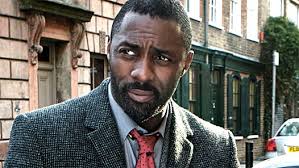
Detective Chief Inspector John Luther (Idris Elba) does not walk.  He stalks and swaggers his way though the grim streets of London often with his hands jammed into his pockets, moving from crime scenes, to interrogations with criminals, to prison cells, to the police headquarters often cloaked in grey shirt or grey overcoat.

In truth, Luther lives in a grey world.  The cinematography seems to continually project these dingy tones, and I suspect if London ever were to have a sunny day, that filming of the show would be cancelled.

It is established early on that Luther is a man driven by absolute conviction and plagued by moral ambiguity.  In the first scene of the first episode, he allows a truly heinous pedophile to dangle from a beam inside a warehouse until he gives up the location of a kidnapped child.  Instead of rescuing him immediately, Luther, clearly in anguish, questions him about the other children he has tortured and killed and tries to extract even more information, until the man (Henry Madsen) finally can hold on no longer and plunges to the floor, critically injured.

Even though Luther is cleared of any wrongdoing, the next episode finds him on the roof of the police station standing at the very edge and contemplating the street far below.  A fellow detective finds him and begins to talk him down, reassuring him that no one would shed a tear over the injuries to Madsen.  Luther responds, “Doesn’t make it right” to which his colleague replies, “It does make it a little less wrong.”

And this is Luther’s world.  He is surrounded by unsavory criminals with whom he must work, and sometimes negotiate, in order to solve a case or protect a loved one.  In one of the most bizarre and chilling twists, he finds himself initially threatened by the psychopathic Alice Morgan (Ruth Wilson) who eventually turns into a trusted ally.  She has committed a double murder that he cannot prove her guilty of and over time comes to think of herself as John’s protector.

Because he is unafraid to work outside the law and occasionally to defy authority in his search for justice, he is, like some superheroes (Batman and Spiderman come to mind) thought to possibly be criminal himself.  Up on the rooftop, he even questions his own actions as he talks with his colleague asking, “Do you not worry you’re on the devil’s side without even knowing it?”  As time goes on he comes under the active scrutiny of a female investigator, DS (Detective Sergeant) Gray (Nikki Amula-Bird) who actively suspects him of wrongdoing.  She turns to Luther’s loyal protégé DS Justin Ripley (Warren Brown) to confide in him and share her suspicions and observations that Luther is a “dirty” cop.  Ripley tries to explain to her that, “there’s a difference between getting your hands dirty, and being dirty.” (Note: all of the quotations sound much cooler with a British accent.)

As he stalks though the world, Luther appears alternately weary, disgusted by the humans he must deal with, and confident that somehow he can make a difference.  He confides at one point that, “I’ve been a police officer since God was a boy.”  When in one scene, Alice confronts Luther’s estranged wife, Zoe, and asks why John pursues his work when it has cost him so much including his wife.  Zoe answers evenly, “He believes that one life is all we have, life and love.  Whoever takes life, steals everything.”  In defending the lives of others, he seems to care little about his own; he lives not expecting love or hope.  In a conversation with one soul whom he has saved, she tells him, “You should be married, be happy and everything.” He quietly replies, “No one will have me.”

Zoe’s assessment of him gives us the clue to his obsessive dedication to the work. He never seems to sleep and never pursues a relationship once he has lost his wife.  In a crime scene, he has Sherlock-like instincts, observing the evidence of a double homicide, analyzing the probable sequence of events, and then confronting his partner, Ripley.  “Am I missing something?  Does that seem right to you?”  Ripley replies, “None of it seems right to me.” Luther then states, “’Cause it’s not right, is it? It’s not right.”  Luther is not someone who breezes in with all the answers, but as the team struggles to put the pieces together, he repeatedly uses variations of the phrases above:  “What am I missing?”  “Something is missing.”  “This isn’t right. “  However, the questions frequently bring on the insights he needs, and he bolts off on his own, confident that he has found the key to unlock the case.

Viewers will either find Luther as a man looking to die or a man so confident in his way of doing things that he has a kind of bravery that borders on the foolhardy.  In the jaw-dropping finale of series 2, a case where the team must track down and stop a pair of psychopathic twins playing a game of murder and mayhem, Luther offers himself up as a sacrifice.  As he approaches one of the twins, unarmed, facing off against the young man who is holding a “deadman” switch connected to a suicide vest with enough explosives to destroy a city block, Luther soaks himself in gasoline, tosses the man a lighter, and encourages him to roll the dice with which he and his brother have been creating havoc.  Either the man will give up, or he gets to immolate Luther.  Luther’s ploy ends up being a brilliant move in a chess game where he ends up being just one move ahead of the suspect.

Luther ends up being my #1 because of the magnificent work of Idris Elba.  With many of the other characters, I marveled at the skill of the actors.  I never felt Elba was acting.  He becomes Luther. According to my reading on this show, it was never meant to be more than one series.  However, plans are in the works for a full-length feature film.

Conclusion

 Whew!  This was a lot of work!!  I’ve gotten so many great comments and suggestions, and I know that I could do this all over again and come up with 5 other great detective characters.  Someone should absolutely do the 5 best female detectives, just to balance out my lack of gender equity.  Maybe I will take that on later, but this has been so consuming that I have not fed my wild birds in the back yard for 3 days and have barely looked at my vegetable garden.  The massive up-side is that I have been able to re-watch hours of these great shows in the name of research.  Labor of love!



“I Am The Eggman”

Image

When asked what led me into teaching high-school English as a career, I have several ready answers–I wanted to dedicate myself to helping young people; I loved reading and writing and was happy that I could make a career out of it; I liked the idea of having summers off—the usual.  And while all of those things were true, I always left out one key factor because I didn’t want to admit it.  I wanted to go back to high school.  I wanted to go back to high school to see if I could achieve a level of “coolness” that had always eluded me as a student.  I’m not proud of it, but there it is.

There were two teachers that most influenced my thinking about this because they provided models for how someone could be well liked and also be a powerful teacher.

Vic Player, geography teacher at Saint Augustine High School, was a man with a bold and playful sense of humor.  I was a painfully shy freshman who just wanted hide behind a large person in class and go unnoticed.  As he was taking roll one day early in the semester, he called out “Waldron?  Waldron?  You mean like walrus?  You are the eggman, you are the walrus?”  I sat in silent horror as I raised my hand to acknowledge my presence and my new connection to the popular Beatles’ song of the time.  “Yeah, Waldron,” he said smiling, “from now on, you are the Eggman.”

And from then on, I was the Eggman.  All of a sudden, I had an identity in the class.  I was someone, and I could no longer hide, no longer wanted to hide.  This man, with one silly nickname, transformed my first year experience in high school by giving me an identity that I could never have carved out for myself.  He refused to call me by any other name from that point on, and I marveled as I watched his easy confidence in the classroom, how he teased, and taught, and cajoled, and nurtured his ninth grade class.  He was by far, the coolest person in the room.  I wanted to be like that.

Three years later I faced the terrors inflicted by John Bowman, my senior English teacher.  The year before I had been in a class next door to his, and we frequently heard pounding, yelling, and then laughter coming from the class.  We were terrified.  All we could imagine was that someone in his class had said something stupid and had been thrown up against the wall, maybe pinned to a cork-board like an impaled butterfly, to be ridiculed by the entire class.  We entered his room, already cowed by the legend and his fierce reputation, the knowledge that he did not suffer fools, and that he did not spare criticism.

To our relief, we quickly discovered that the pounding came from Mr. Bowman slamming his hand on his desk for emphasis, as frequently in praise for a good comment as in disgust for one that didn’t please him.  Our written work was treated with contempt for most of the first quarter, but we quickly learned how to write and how to please the great man.  There was no better day, no greater compliment, than the moment when he called on me and I ventured an answer to a question and he slammed his hand on his desk with satisfaction.  “Mr. Waldron!” he shouted. “Say that again!”

It took most of the year to figure out how much he loved his class.  We knew he loved literature.  His passion swept us away—Sophocles, Shakespeare, Thoreau, Hemingway—all of them were heroes, giants.  However, he was a consummate actor and hid his affection for us as long as he could.  By the end of the year, when he handed out his own home-made awards for excellence, we were allies with him in his secret.   The incoming juniors would never know.  But I knew.  And I wanted to be like that.

As it turned out, I could never “be” either one of those two exemplary teachers.  However, I learned some of my key values from them—passion, humor, a dedication to excellence, and a commitment to making every student feel included, honored, respected.

If students remember anything from my classroom it will be the fact that for the last 15 years or so, I greeted every student, every day, with a handshake.  It provided a short, personal moment of acknowledgement for every one of my kids.  It became so ingrained as a classroom ritual that if I forgot and started class without having made the rounds, students would cry out in protest. One student described it this way in an end-of-the-year note to me: “Taking those few minutes out of your day to talk to each student, really made a difference especially during a time where every teenager is struggling to figure out who they are and where they fit in.  It was nice to know that at least one teacher cared enough to take those few seconds out of their day to treat each student like a real person, not just another face in the crowd.”

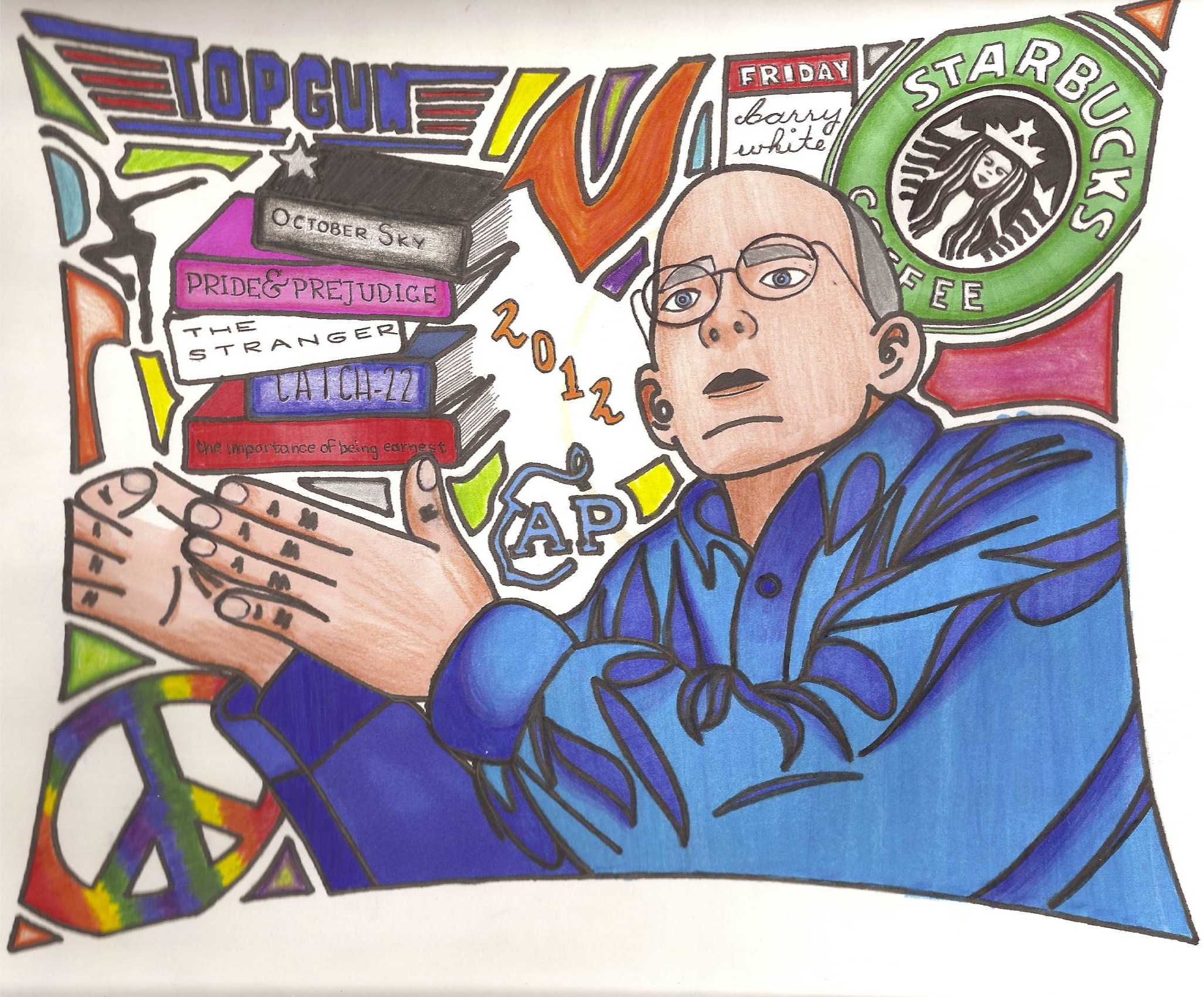
So, did my 36 year-high-school do-over achieve its purpose of giving me a status I couldn’t quite grasp the first time around?  Not exactly.  While I gained a certain amount of notoriety for my classroom traditions such as the handshake, loud music to begin each day, Barry White Fridays, movie nights, and the year-end scrapbook, I pretty quickly realized that I was there to make my kids feel special as they tried to survive high school; to make them feel accepted, and cool, and as if they were in a place where they belonged.  It was when I had a really good day in helping a student, that the Eggman felt cool once again.


Thank You, Paul McCartney

Baby, I’m a man, maybe I’m a lonely man

Who’s in the middle of something

That he doesn’t really understand…

I have to admit, despite my eventual qualms about all things Catholic, it was a good decision for me to attend Saint Augustine High School, an all boy’s Catholic school in San Diego.  All freshman had to endure a period of hazing, which included wearing a beanie with the purple and gold school colors for the first six weeks, and being taunted and ordered about by upper classmen, but it was tolerable, and a part of a fierce sense of school spirit, loyalty, and tradition.  The entire school could fit inside the gym.  We did so every Friday during football season, and I can still feel the sense of anticipation as we waited for the band to begin blaring out “When the Saints Go Marching In” as the football team marched in and began a loud and raucous pep rally.  I had excellent teachers for the most part and was proud to be a Saintsman.

Meeting girls, though, was a different story.  Our school took turns hosting dances with the local Catholic girls’ schools, but I found them uncomfortable and awkward, full of a multitude of opportunities for rejection and only slim hopes for satisfaction.  I did managed to go on a couple of dates in my first two years, mostly with girls who were as scared and awkward as I was, but still found them to be mysterious and confusing.

Then one day, I hit the jackpot.  My friend, Pat, a drama kid, came to me and begged me to join the musical production of “The King and I” at Rosary High School, the nearby girls’ school.  “You don’t have to be able to act OR sing,” he reassured me, “they just need guys.  Anyone can do it.”

So, I joined the production for the simple reason that I knew that the girls would vastly outnumber the boys, and I still had hopes as a junior that I could salvage at least some valuable and maybe even memorable social experience before I graduated.

It was my first exposure to drama and in my 16-year-old-eyes, we slowly mounted a magnificent production on the tiny high school stage. The only musical accompaniment was a single piano played by the enthusiastic and dictatorial nun who was also the play’s director.  I had seven different parts in the play, all of them non-speaking.  Nightly, I had to smear my body with a base make-up to make my pasty skin look bronzed and I spent every performance racing from costume change to costume change, just trying to be in the right place in the right time.

Having never been in a drama production of this magnitude or of any magnitude, I was a little overwhelmed by the emotion of closing night.  Even before the final curtain call, there was a tremendous amount of hugging and kissing going on and I was intent on being involved in as much of it as I could be.  In the midst of this vortex of emotion, one of my friends nudged me over towards Dolores, a lithe, beautiful Pilipino girl who seemed intent on passionately kissing every boy she could get her hands on.

I should mention here that I did not then, and even sometimes do not now, have a clear understanding of the appeal of French kissing.  My only introduction up to that point had been my older sister and her boyfriend showing off in front of my younger sister and I who both agreed the behavior was completely disgusting.  My older sister sneered at us.  “You’re too young to understand,” she sniffed.  Whatever.

But when suddenly I found myself in Dolores’s arms, she was kissing me with her mouth wide open, something that immediately made me feel I had become connected to a lovely but out of control vacuum cleaner.  She seemed to be waiting for me to do something, but I had no idea what it was.  I was just sure I wanted to kiss this way as long as she would let me, hoping maybe I would figure it out.  We broke the kiss and I stumbled away with a sense of wonder, loss, and determination.  I had to have a second chance.

The chance came a week later.  My school had a junior-senior prom coming up and so I had been casting about in my mind for who to ask.  After that night, my sights were set firmly on Dolores.  She had no good reason to go with me except that we knew each other from the play and as a sophomore girl she had never been to a prom.  It was just enough for her to say yes.

Proms are supposed to be about flowers, tuxedos, music and pictures, but in my mind, the dinner, the dance, and the after-prom were simply 10 hours of foreplay leading up for a chance to kiss her goodnight. Through the first part of the evening, she was a delightful date.  I still remember the aqua-colored dress and her long, lustrous hair done up beautifully to frame her delicate face. I, at times, could not believe that I was there with a date as lovely as she.

Things took a turn for the worse at the after-prom.  Suddenly Dolores disappeared and from the reports I was getting from my friends, she was chasing after Rocky, our star wrestler, a friend of mine, while I sat disconsolately by a pool table in the bowling alley.  After a miserable hour or so, she re-appeared, looking bored, and finally, it was time to take her home.

I walked her up to her front porch feeling a little sulky.  After all, she had bruised up my ego pretty well.  Of course, I had asked her for the shallowest of reasons but still, was one night of pretend loyalty too much to ask?  My feelings weren’t hurt so badly that I didn’t feel a rush of anticipation as we approached her front door.  She turned and smiled and thanked me, and the smile was enough to melt any resentment I had felt as she drew me toward her and once again kissed me deeply and passionately and for the last time.  Somehow during that kiss, that I hoped would last forever, she taught me what I was supposed to do.

I drove home in a daze and I can still hear Paul McCartney singing, “Maybe I’m Amazed” on the radio, which seemed perfect at that moment.  The sun was coming up, and I was immersed in the wonder and mystery of love and lust, hope and loss.  I had a feeling the world had just grown for me a little bit.

Thanks, Paul, for crystallizing that experience for me, freezing the moment in a way that only a song can do.

Baby, I’m a man,

And maybe you’re the only woman who could ever help me.

Baby, won’t you help me to understand?