A Handshake A Day…A Classroom Practice That Changed Everything

601px-Handshake1.svg


During my 36 years of teaching English at the high school level, I attended many, many “professional development” workshops. I will let you in on a secret. By and large, teachers are terrible learners.

We demonstrate every bad behavior that we spend all day chastising our students about. We don’t pay attention. We pass notes. We ignore directions. We grade papers instead of attending to the presenter. Smartphones have made us even more inattentive, since now we can check email, Facebook, or chat with our friends across the room via text messages.

It is not our fault altogether. The workshops frequently do not meet our most critical or pressing needs. They are often planned by administrators who have lost touch with the classroom. And especially bad are the district-sponsored sessions that are designed to indoctrinate teachers into THE NEXT BIG, IMPORTANT THING IN EDUCATION which they are convinced we must begin to implement immediately. Those of us who have been around feel a touch of cynicism about such roll-outs because we know it is likely to be just a couple of years before we are dragged back into the same room to hear about THE NEXT BIG, IMPORTANT THING IN EDUCATION which not only replaces its predecessor, but likely undoes all of the work we just completed implementing for the previous program.

However, one spring afternoon our staff gathered for a half-day workshop with a focus on the importance of boosting students’ self-esteem. This was some time ago when caring about students as individuals was considered as important as producing good test-takers.

The woman presenter was earnest and sincere and I’m sure she gave us a lot of good ideas and strategies, all of which I have now forgotten—all except for one. She told us that she stood at the door of her classroom at the beginning of every period and shook hands with every entering student, greeting every student, every day.

She claimed it was the single most influential thing she had ever done in terms of creating a warmer and more welcoming classroom environment. She claimed that once she began, her problems with discipline were greatly reduced, her students felt better about her and about themselves and most remarkably, that she could wait until the end of the day to record her attendance because she could actually remember who had attended that day.

“Hmmm,” I thought. This actually sounded like something.

There were so many reasons NOT to try it. First of all, we were nearing the end of the year, with barely 6 weeks of school remaining. Introducing a new ritual, a new daily practice would be awkward, both for me and for them. My classroom had two entry doors, so I’d be unable to greet them coming in the door. I’d need to wait until they were seated and then circulate through the room killing more instructional time. Most of all though, the thought of it made me feel vulnerable. I imagined that the kids would think it strange, forced, artificial. I convinced myself several times to put it off to the beginning of the next year. After all, it would be so much easier to start off the year with a brand new group of kids who had no expectations, who would be less likely to see this new practice as being a weird departure from the norm.

But the idea gnawed at me all weekend. If it was really that good, if it really made that big a difference, why not take it on a test drive for 6 weeks and see if it really could have the kind of impact that the presenter had suggested?

I was nervous on Monday morning. The first period kids sat down at the bell, and I began circulating up and down the rows with my first official handshake of what would become a ritual that would endure throughout the rest of my career. Students were surprised, puzzled, skeptical, and amused as I went around greeting each kid briefly. Once I was done, I certainly had their attention because they all wanted to know what the heck that was all about. So, I told them the story of the workshop, of my decision to experiment with them until the end of the year. After we had given it a try, I told them, I’d let them tell me what they thought, whether it was something I should continue with or not.

Over the next couple of weeks, we all became used to the new ritual. I began to look forward to this way of beginning each class. I liked that I had a brief moment each day to acknowledge every student in my classes. If I had a concern with one of the kids, I could pause at his desk and consult with him for a moment. Likewise, the students discovered that this was a good time to stop me if they had a particular problem or question to which they wanted to alert me. I found myself giving impromptu handshake lessons when students would offer up what I called a “dead fish handshake”, letting their hand lie limply and passively in mine. I felt like I was performing a public service by preparing them for using the proper “business handshake” that they would need as they eventually made their way into college and job interviews.

As the year came to a close, I did not feel as though I had seen a huge transformation in the classroom atmosphere. I had, however, begun to feel a significant change in me. By spending that moment every day with every student, I began to be much more aware of the uniqueness of each kid. Especially important to me was that it gave me a chance to chat with and acknowledge those who were very quiet or shy. They couldn’t hide when I was standing over them with my hand outstretched and, over time, I think they appreciated the attention.

During finals I surveyed the class and asked them how they had felt about our little experiment. It had become so routine by then a lot of them shrugged their shoulders. “Fine” some of them mumbled. One brave soul raised his hand to comment, “What I noticed, Mr. Waldron, was that it was really hard to be mean to you when you took time to shake our hands every day.”

Well, that was enough of an endorsement for me. I continued shaking hands for the next 15+ years, every kid, every day. Through it, I discovered not only the importance of creating a non-threatening physical connection, but the importance of having unique classroom rituals. The handshake made our classroom special because no one else (that they knew of) was doing it. Howls would go up if I mistakenly tried to begin class without handshakes first. Returning student might not remember a single thing I had taught them about reading or writing, but everyone remembered our daily routine.

One student who wrote to me on the occasion of my retirement in 2012 summarized it nicely: “I remember your daily handshakes (or fistbumps if we were sick) like it was yesterday. Taking those few minutes out of your day to talk to each student really made a difference, especially during a time where every teenager is struggling to figure out who they are and where they fit in. It was nice to know that at least one teacher really cared enough to take those few seconds out of their day to treat each student like a real person, not just another face in a crowd.”

Just a few minutes a day. Such a simple thing. I’m so glad I was paying attention during that one afternoon workshop so many years ago.
Please, Please Don’t Make Me Think!!

dexmedia


From time to time, I return to the high school where I spent most of my adult life, filling in as a substitute teacher for friends of mine. Having taught freshmen during the last year before my retirement, there is still one cluster of students who know me as a “regular teacher” and they are all now seniors, getting ready to graduate. For the past week, I have been substituting for a teacher who has mostly seniors, and I’ve been re-united with many of my former kids.

It was during some slack time in one of those classes that Luisa, one of my former freshmen, asked if she could do a brief interview with me for an assignment she was trying to complete for her psychology class. She had three questions that she had to ask of someone younger than her, someone older than her, and someone who was of “post-retirement” age. She laughed when I said, “That’s a nice way of saying that I’m the old person of the group.”

It would have been much easier if I had been inclined to give glib, easy answers, but each question hit me as being tough and thought provoking.

Question 1. “What has been the best age in your experience?”

I immediately assumed she was talking about “best decade” as opposed to “best year” and I found myself torn. I had six decades to choose from. I discounted the first two, eventually narrowing it down to either my 20’s or my 60’s (although I’m only two years in). These were/are decades where I have felt the greatest personal freedom, especially freedom from responsibility. I have always taken my responsibilities as a husband, a dad, and a teacher very seriously, but now, when I see a responsibility heading my way, I duck and hide and hope someone else will get stuck with it. I am both highly responsible and responsibility-averse at the same time.

After some thought, I settled on my 20’s. On the one hand, I had less money; on the other hand, I had many fewer aches and pains. I had the energy and enthusiasm of youth and was in the midst of finishing college and beginning a new career. Most especially, though, I remember those years as the long honeymoon of my now 40-year marriage. Married at 21 to a girl I had loved since high school, I’m sure those years are hazed with a golden glow of nostalgia, but for me they were a time of being young and free and in love. As we set up our first home together, a two-bedroom duplex, we worked at blending our different images of what “home” looked like and started to learn what it really meant to be partners. We learned how to have fights. Best of all, we learned how to make up. We could spend lazy hours together on a Sunday afternoon with nothing but each other’s company and feel utterly fulfilled. I remember watching her stand at the bedroom mirror, brushing her long, black hair in the evening, marveling at her beauty and at my good luck in having found her.

That decade was capped off with the birth of our son Nico, and the exciting, demanding, and immensely fulfilling beginnings of parenthood.

Question 2. “What age do you consider “old”?”

Ouch. The face I see in the mirror every morning says that I am old. Scrolling back to 1953 on my laptop whenever I have to record my birth date for some government form is certainly an eye-opener as decade after decade slips past. The constant aches, the more frequent doctor visits, the amount of time needed to maintain a body that once seemed to take care of itself all scream “OLD, OLD, OLD!”

But given all of that, I don’t FEEL old. And I am around OLD a lot. My mother resides in a board-and-care home, a residential facility that can house no more than 6 residents, all of whom need 24-hour attention. The oldest resident there is now 99 years old and until just recently was as spry and sharp as could be. He is my hero. My mother clocks in at 92 years of age, placed in this home due to her growing dementia and lack of mobility. I visit nearly every day, at least for a while, and doing so for the last three years is beginning to age me a bit, I think. Every day, I’m reminded of what the ravages of age can do no matter how hard one might try to fend them off.

It was these many visits that informed my answer to Luisa about what I considered to be old. I told her I could not pinpoint a particular year. For me, it seems that there will come a time when I start to feel that my body is beginning to rob me of my ability to be active in the way that I want to be, the way I am now.

I’m no Stephen Hawking. I don’t expect to be heroic as age or disease begins to chip away at my well-being. I expect to be pretty pissed off about it and to rage a little against the dying of the light. I am just happy that I am not there yet.

Question 3. What is the most important life lesson that you have learned?

 “Is Your Love Enough? Or Can You Love Some More?”

Singer-Songwriter Michael Franti reels off these and other rhetorical questions in his song, “Is Love Enough?” I hate rhetorical questions. There are enough things in my life for which I have no answers. I don’t need more.

Man, where do I even start? I said it poorly to Luisa at the time, but essentially what I wanted to say was that I now knew that I needed to learn to love—more freely, more completely, more vulnerably, more fearlessly. I was raised in a family where we never actually talked about love, didn’t even use the word with each other that I can remember. I don’t think it was until my daughter moved away from home that I got trained in ending a conversation with the words “I love you” because she kind of insisted on it. In my own relationship I have always struggled to be demonstrative and, instead, have hoped that actions would show the love I felt. It is not enough; I know that now.

I believe now, that meaningful human connection may be the most critical element of happiness, and yet these relationships seem fraught with land mines to me. Families are complicated; friendships are complicated; I mean, people are just fucking complicated.

But, I do love the comfort of my family, where affection comes almost unconditionally and instantaneously. Outside of my family, I think I may have only said the words “I love you” to three people in all of these years, and in every case I feared I had said something I shouldn’t, revealed too much, invited an unwelcome response. Why am I so afraid? Is it really that hard to love? To claim a feeling that I know that I have?

On my final day as a teacher, the staff gathered together, as we do every year to honor retirees. The principal said nice things and gave out gifts and awards. Three of us were retiring that year and I ended up going last. The first two wept as they addressed our colleagues and there were tears all around. I didn’t get it. I mean I did, but I didn’t. And I said so. I told them that I could not be happier at this moment, and I hoped that they were all happy for me. I had had a wonderful career and was getting the chance to retire and experience a whole new life. I told them that especially in my final years I had come to love, yes love, the students that I taught. The kids had given me so much love and affection and support that it was easy to forgive their occasional transgressions and bursts of immaturity.

As the ceremony ended, I could hear the skeptics. “Love my kids? I’m not there yet!” I overheard one teacher say. I hope she gets “there.”

Three supposedly simple questions. Just another assignment for a kid (a really great kid), one more occasion for my brain to ache, for my mind to explode.


I Like Myself Just The Way I Am–Except For This One Thing

willpower

I imagine that the issue of New Year’s resolutions has been blogged to death and dropping another on you after February 1 is probably bad form, but I have my reasons.

The delay was due in part to the lingering effects of a bad cold and severe case of post-traumatic holiday syndrome. I was literally paralyzed for a week once the dust settled trying to sort through my feelings about this time of celebration and all of its attendant disappointments, unfulfilled expectations, guilt, and family drama. Don’t get me wrong, there were some very nice moments, and it’s always lovely to get to spend time with my adult children, but it was about one week into January when I exhaled, not realizing I had been holding my breath since November.

But I smugly began the new year with a leg up on most “resolvers,” those who make resolutions that they will not only not fulfill but if asked a year later won’t even remember what they resolved in the first place!

The remembering has never been a problem for me because I’ve had the same three resolutions for years: exercise consistently, lose some weight, write more. It just so happens that I achieved all of those goals this past year for the very first time. It is a rare day that goes by that I don’t get out for my 3-mile walk, or hit the gym for a swim, or spend an hour doing yoga. A direct result has been that I have dropped about 8 pounds, regained a notch on my belt and now fit into some clothes that I was about ready to donate so they would not spend all of their time taunting me from the depths of the closet. Then, beginning this blog in March provided the inspiration to produce 25,000 words, give or take, neatly packaged into 20 distinct articles.

The most shocking part for me about the writing is that I actually have readers, to whom I am grateful beyond belief. Thanks to the info that WordPress keeps, I even know where in the world my readers are primarily located. It turns out that there is group of crazy Brazilians who frequently read my stuff. And I want to know who you people are so please, drop me a comment and let me know why you don’t have something better to do than follow this blog!

However, no matter the self-righteousness that I feel I have earned over the past year, I also feel compelled to tell you that I do have a resolution for 2015. It’s a secret. Please don’t tell anyone about it. I am not confident at all that I will make a dent in this one.

beers

Truth be told, I like to drink beer. I like to drink more beer, more often than some of my relations, my doctors, and conventional wisdom think is appropriate. Since it gives me pleasure, I know instinctively that it must be bad for me and that I should cut back. Cutting back, I have found, is hard. In fact, I suspect I would have better luck giving up alcohol altogether than to try to be consistently moderate. Being moderate just sucks. However, cutting back is my resolution for 2015.

Let’s face it. Medically, it makes all the sense in the world to reduce my alcohol consumption. Anything that can eventually destroy my liver is a bad thing. However, I have gotten very mixed signals from my doctors when we have talked about this. My GP suggests “just one or two per night” but then warns me not to cut it out altogether because it could adversely affect my blood pressure. My therapist said to quit worrying about it, that at the level I was drinking if I were to cut off a couple years of my life they’d be the worst couple of years of my life anyway (I like him). A cardiologist I met with gave me a fish-eyed look and said “one.” He looked like a man who took pleasure in taking away the pleasures of other and instinctively I did not trust him. One final health professional confided in me that actually 3 or 4 drinks is now considered “moderate” but that no doctor will actually tell that to his patients (I like him).

So I need an additional motivation. Not wanting to be a slender guy with a prodigious beer belly is certainly one of them. At 150 calories per 12 oz bottle of premium beer, consuming an extra 300 or so calories per night must mean I’m in a constant battle to maintain my weight, right? But, in fact, I’m not. I’m very conscientious about my diet and I exercise religiously. As I have looked for beer substitutes, something to sip on that will be satisfying, tasty, but not alcoholic, I discovered that virtually all of them have just as many calories and many throw in the evils of processed sugar and caffeine. If it’s not water, it’s not a good trade-off. Also when I have given up beer for a week at a time and maintained all of my other good habits, I expect the pounds to just absolutely fall off of me. I want to see my weight drop at least one pound a day to compensate for the pain of abstinence. It just doesn’t seem to work that way.

And there is the WTF factor. I do not live each day to the fullest and in fact, I don’t think anyone actually does. Many days are full of trips to Target and the dry cleaners. Others to grocery shopping, cleaning and paying bills. It’s just life, and I’ve been lucky to have enjoyed an awfully good one for 62 years. On my way to the sports section, I can’t help but glance at the obituaries and take ghoulish pleasure in the growing numbers of complete strangers that I have outlived.

Sadly, I have also lost former students, friends, and colleagues who died far too young, taken by accident and disease. I’ve seen young friends felled by stroke and brain tumors. Being aware of life’s capriciousness has not exactly made me fatalistic, but what the fuck? Knowing that I can get taken down by some kind of heinous disease at any moment, I’m less inclined to follow the arbitrary rules of healthy beer consumption. Besides, it tastes good—really good.

And, it feels good to be a little bit bad. I was an altar boy as a young man, a fanatic rule-follower. I don’t think I knowingly broke a rule until I was 34. I am the guy who will stop for a red light at a crossroads in the middle of the desert at three in the morning, waiting for the light to turn green. To my great frustration, I will not allow myself to commit adultery even in my in my dreams (“Gosh, sorry, ma’am. I’m awfully flattered, but it just wouldn’t be right, me being married and all. I hope you can understand”). An extra beer at night feels like a small revolution, a salute to independence, a raised middle finger to all of the conventions I have followed for so long.

And there is an illusory effect that beer has on me that all experiences are enhanced by drinking. Television is better, music is more profound, the book I’m reading is more moving when accompanied with my favorite IPA. I am absolutely certain that the sunset is more vivid, the moonrise more spectacular, and that the fire is warmer and more captivating sitting outside by my outdoor firepit welcoming the night with a cold one. Likewise, when writing, the words seem flow more easily, my mind races with ideas, synapses are firing that I didn’t know existed, and at times I’m convinced I’m pouring out nothing but brilliance as I sip on my drink. This is before I humbly proofread my work the next day in the very sober light of the following morning.

These are all of the reasons that I will fail miserably with my one resolution for 2015. Here is the reason I will succeed.

I like to feel good when I wake up in the morning. I like to wake up and lie in bed planning out my day without a dull headache, a hazy memory, and a rumbling stomach. When I get up in the morning after a non-drinking night, I feel cleansed and righteous. I feel the same way I used to walking out of the confessional as a youngster knowing that my sins (which were nothing close to sins at all) had all been washed away. I feel more alert and have more energy as my day begins with that glow of well-being filling my soul.

We will see, in 11 months, if that is enough to turn the course of a deeply-rooted habit–a habit I really enjoy. Not giving it up, mind you. Just cutting back.


“Just Dropped In to See What Condition My Condition Was In”

depression-anxiety

Note:  Thanks to Kenny Rogers and the First Edition for the title (you have to go way back to know that one!)


Of course I’m depressed. I mean, who wouldn’t be. Ebola, climate change, Supreme Court decisions, police injustice, terrible things going on in Syria, Iraq, and Iran. There are days that I have to avoid the front section of the newspaper altogether. I withdraw to the sports section where I can be comforted by the complete meaninglessness of whether or not the Sixers will win more than one game this year, or court the anxiety of my Chargers trying to stagger, once again, into the playoffs, and ponder if the Padres are about to make yet another horrible trade.

On my worst days, I figure that anyone who is not depressed is just not paying attention.

And this is one aspect of me that drives my wife just a little crazy. After all, I don’t actually have Ebola. Like most Americans, I have little say over the direction of the country, and people much smarter than me have failed miserably to guide events in the Middle East. No one at the Padres or Chargers seems much interested in my advice as sound as it might be.

Instead, right at this very moment, I’m writing as I sit out on my deck, drinking a beer, and enjoying a lovely, San Diego sunset. I am in reasonably good health. I’m retired which means I don’t have to do anything on a given day, although I do enjoy substitute teaching occasionally, attending adult school classes, hiking, taking long walks, reading, writing, doing yoga, swimming, traveling, and gardening.

In other words, from the outside, it would seem that I have no good reason to be depressed. I have no good reason to be anxious.

And yet, I do get anxious. I still slip into depressive periods. I start to see every setback as a personal failure. The car breaks down and in my mind, it spirals into a catastrophe. I make a simple mistake on a project and I curse myself as an “idiot.” I get disoriented in an airport, and I start to panic. How come everyone else knows where they are going? I am a sponge for other people’s sadness and for the troubles I see in the world. I get a headache, I worry about brain tumors.

I’ve been seeing a therapist for depression and anxiety for over ten years now. I was encouraged to seek out help because I kept slipping into depressive episodes as I became overwhelmed with work (an almost constant condition for a teacher), and because I noticed how I increasingly reacted to everything and everyone negatively, sarcastically. I resisted for quite a few years, but now I take medication to even out the highs and the lows. The sessions were frequent at the beginning. Now, I go in every couple of months, just to check in, just to make sure that I’m still moving in a positive direction.

It’s not something that I share lightly, but also something I’m not afraid to share especially with my former students who from time to time have in the past, and still today, seek me out in times of distress.

I came to know early on in my teaching experience, just now little I knew about the lives of my students as I interacted with them for my 54 minutes per day. If I saw a kid obviously in distress, I would take him aside and offer support and give him a chance to talk. Some students welcomed the attention. An equal number resented the intrusion.

Others were in pain so close to the surface, that the slightest interaction was enough to cause them to open up. One girl came in after school, ostensibly to talk about a problem with writing, and promptly dissolved into tears. What she really needed was to talk to someone about her mother who was creating chaos in her life. I once teased a young woman about the baseball cap she was wearing, whereupon she burst into tears. I took her aside and we spent the next two hours (and a good chunk of the following year) talking about the very painful break-up she was experiencing with her first boyfriend.

Just last week, helping a former student finish her college essays, we ended up talking about the pressure she was feeling from her parents, how she often felt isolated, how she felt guilty about moments of enjoyment, about how she felt somehow she didn’t deserve to be happy.

All three of these students were young, vibrant, bright, engaged young women. They were all high achievers who expected much of themselves. All three had a very hard time seeing beyond their present crisis or beyond their present way of thinking about it.

Somewhere in my conversations with all of them, I brought up my experience with therapy, with having to seek out some support, with how I came to realize that I needed professional help. Invariably, my students are surprised by this because the impression I give to my students when I am in front of a classroom, is that I am a positive, happy, high-energy person. They come to assume that I am like that all the time. What they didn’t know was that persona would pretty much collapse after 6th period on any given day.

Like these three young women, before therapy, I didn’t have strategies to cope with outside forces that I couldn’t control. I couldn’t understand why I didn’t quickly bounce back from the debilitating pain of loss. I often felt like a fraud and was incapable of accepting a compliment gracefully.

The most startling part of entering therapy was discovering how normal I was. I still remember in the first few sessions, as I started to describe the thoughts that plagued me, as I unburdened myself of all of the stuff I had been carrying around with me for so long, how utterly unimpressed my therapist was. “Yeah.” he responded. “You have a number of what we call “cognitive distortions” which is just a fancy way of saying that over time, you’ve come to distort the way you look at yourself and the world around you. You’re not an idiot, every setback is not a crisis, lots of people get lost in airports, and you probably don’t have a brain tumor.”

Then he handed me a list of “Common Cognitive Distortions”. There were 15 of them. They had neat little labels. The situations I had described fit nicely into 5 or 6 of the categories and I could see hints of how I perceived the world in 4 or 5 more.

I felt a little deflated. I thought I had really serious issues and here they were all boiled down into nice little boxes, all described on a single sheet of paper. I wasn’t anguished after all; I was mundane.

That last sentence is an example of a cognitive distortion. I just can’t remember which one right now.

Of course, my concerns and the pain I felt were real. The work it took to begin to recognize and respond to years of perceiving myself negatively was hard, and I have had to learn some lessons over and over again. The ruts in my ways of thinking are deep and even now, I fall back into them. That’s why the check-ups continue to this day.

I certainly do not share all of this with my students who are in distress. What I mostly do is listen to their concerns, share similar experiences that I have had, and most especially make sure there is help and support available to them. If I feel they might need the help of a professional, I try to demystify that experience for them. It’s amazing how comforted they seem to feel to know that a trusted adult has also struggled, has sought out professional help, is still working on personal issues that are not always all that different from their own.

If anything, I try to help them to feel normal again, to feel mundane—but in a good way.


Purging vs. Saving: A Dilemma

eyeball


When my children come to visit, I now will frequently present each of them with a “present”—one or more plastic boxes, full of their belongings, which they have decided to store in my garage even though neither of them has spent any serious time living at home for the past seven years.

Clothing, horse show ribbons, plastic horse collections, notebooks from both college and high school, and most especially, college textbooks which I know they will never, EVER open again, populate every free space that I can create. I have made a simple (and I think quite generous) rule regarding retention. If they really want to save it, I’ll keep storing it. But they have to look at everything and make a conscious decision that the object still has value.

My dedication to purging was inspired by the painful experience of having to empty my mother’s home when, two years after my father’s death, she was injured and precipitously consumed by a dementia that had been creeping into her life. Her condition required that my sister and I place her in a board and care home where her living space was reduced to an 11 x 11 single room from the spacious mobile home that she and my dad had enjoyed for over 30 years.

The “purge” was a combination of an exciting exploration of memorable objects and a tedious and painful exercise in laboriously making decision after decision regarding what was worth keeping. Pictures, jewelry, and silver, antique dinnerware—those were easy decisions to make. Kitchenware made its way to the kids and family members who had a use for it, but most of their furniture was dated and quickly donated. My sister and I created a system for tossing stuff. “You want this?” one of us would ask. If the answer was “no,” it was trash. My parents weren’t hoarders, but they did keep at least 10 ashtrays stored away even though they had both given up smoking over 25 years before. We must have easily filled a dumpster with the life they had formerly lived.

And my mother saved paper. Virtually every document that was related to taxes, investments, bank accounts, insurance, health care—anything that looked vaguely official—was squirreled away into a semi-roll-top desk that someone else is now enjoying because I couldn’t fit it in to my house.

I spent hour after hour looking through every one of these documents to determine what actually needed to be saved. I ended up with four hefty boxes of documents that I deemed to be unimportant and took them to a professional shredding company (who knew such places existed?) but also found my father’s service records from World War II, my parents’ marriage license, birth certificates, and other family records that even I couldn’t bear to part with. These were the tangible evidence of some of the most important aspects of the lives of my parents, and I found myself struggling to let them go. I even kept my grandmother’s Social Security card. Now, when will I need that?

And that’s the crux of it—Irrational Emotional Attachment. IEA.   It’s probably a certified psychological syndrome. If it isn’t, it should be. It causes us to keep around mounds of stuff that no one will ever want, that we will never look at or use. Even someone like me, who likes to get rid of stuff, falls victim to IEA.

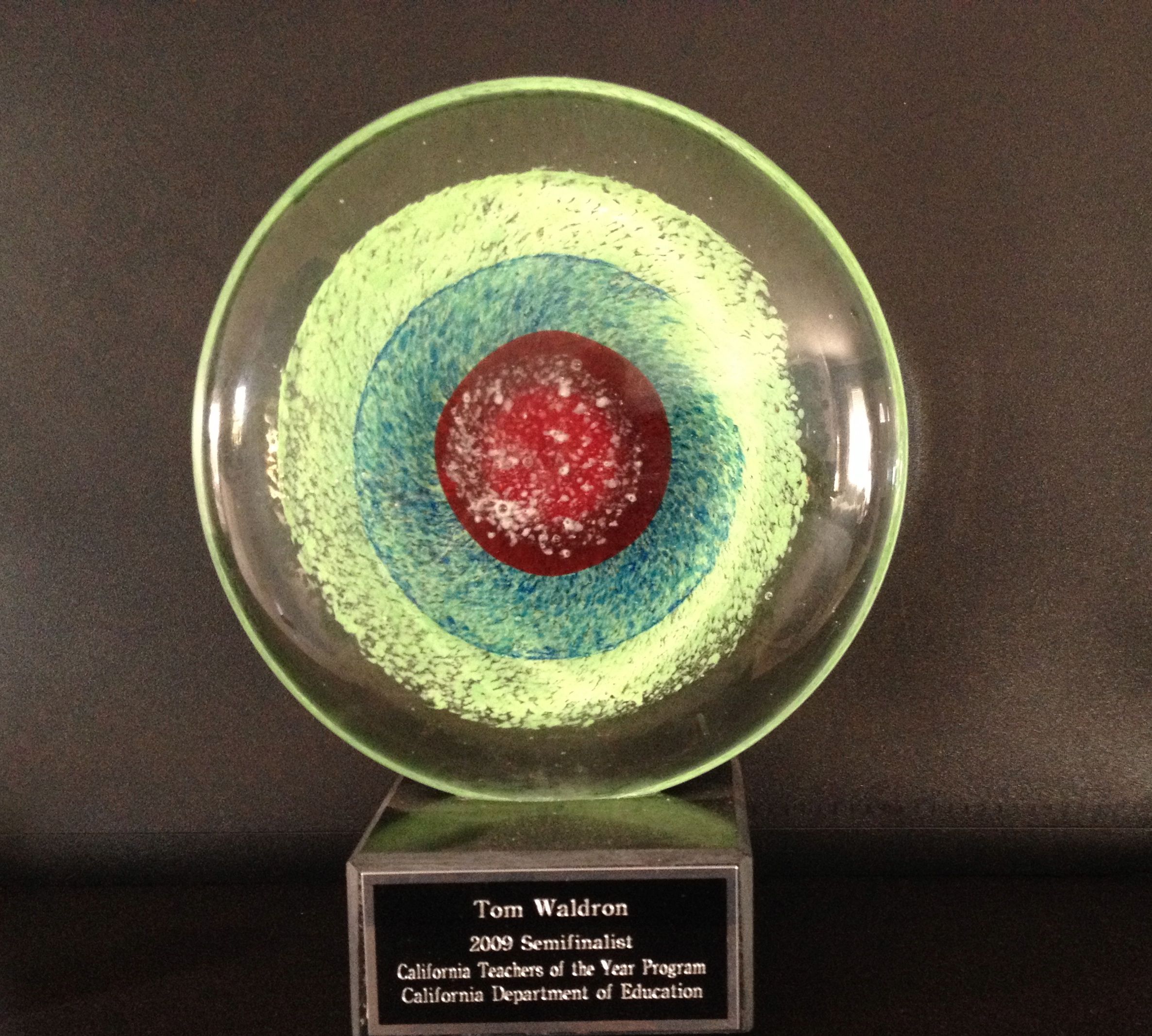
I had the good fortune of being chosen as one of five San Diego County Teachers of the Year in 2009. As a result, I made a number of appearances where I received numerous acrylic “awards” which I displayed for about a year and then boxed up. I never look at them, but can’t throw them away. Someday, one of my kids will. The one exception may be the most nominally significant one—an award recognizing me as one of 12 semi-finalists for California teacher of the year. It is a hideous acrylic creation that we dubbed the “menacing eyeball”. As I packed it away, I remarked dryly to my daughter, Emily that “you guys will be fighting over this someday.” For all I know, it will go the way of my parents’ ashtrays.

So, in the spirit of purging, I took on “the box.” For years, I have wrapped up and saved what I thought was a box that only contained the correspondence between my wife of 40 years and myself when we were interested/dating between the years of 1970 and 1974. Two weeks ago, I broke open two layers of plastic and dove into this archive. In addition to our correspondence, I found letters and cards from former students (one of whom had suffered an untimely death), letters from my high school classmates (one of whom had suffered an untimely death), my own high school memorabilia, and letters from former girlfriends and from Mary’s (my wife) friends, some of whom I dated while I was waiting around for her to notice me.

Some cards and letters were easy to discard, their authors being long forgotten, but others were much harder, a clear case of IEA. They told stories of connections with students who I had managed to support during traumatic times, cards from parents who had appreciated my efforts, one former student who I had helped out as a teen just to become her children’s teacher during the last year of my career. Throw them away? Logically, yes, I should. But no, they went into the “save” pile.

These earnest letters from parents and students make up more of my legacy from teaching than any award I might have received.   They make up a nearly 40-year history of working in a profession that I loved. When I look back at them, I like to think that they are representative of me being my best self. They remind me that teaching was so much more than a lesson well planned or another set of papers graded.

I will still open these cards and letters from time to time and enjoy those memories. I promise, I will throw one or more away every time and whittle away at the number that must some day face the shredder.

Next up! What I discovered in the mounds of letters that Mary and I exchanged during our long-distance romance. Ah, young love—It’s a beautiful thing!

Cool People Need Not Apply

Tom


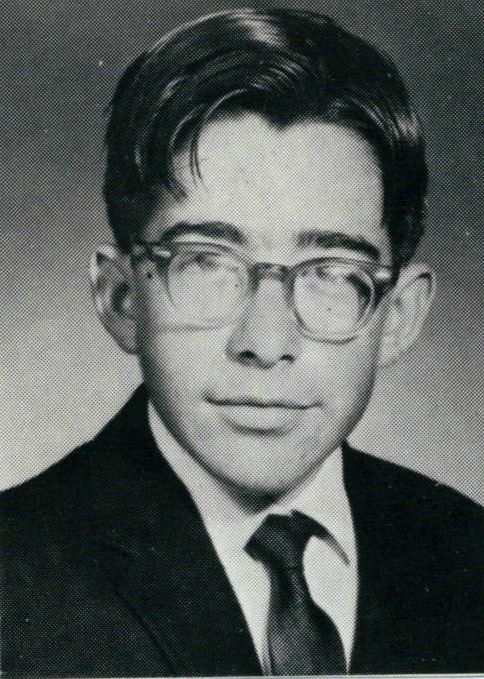
Yes, by posting my ninth-grade yearbook picture, a pic I usually keep under lock and key, I’m taking one for the team—the team of all of you who hate any pictures of yourself from high school. This is not a look I would wish on anyone, especially a young high-schooler hoping for some degree of acceptance and popularity.

I did not enter high school thinking of myself as a nerd, but I certainly had all the essential elements of what I now consider to be an outdated definition of nerd-ity. There was no tape on my glasses, and even I knew better than to use a pocket protector (after all, that’s why I kept a pencil box handy), but my social awkwardness, painful lack of self-assurance, and absence of athletic ability led me to focus on the only thing I was good at—academics. Clearly, in the strict stratification of high school society, I had “nerd” written all over me (see picture above).

I attended Saint Augustine High School, an all-boys Catholic school in San Diego, and sitting in freshman orientation, I felt incredibly alone because there were boys from all over the county, but very few from my small parochial school. I immediately latched on to the first person who was nice to me, Ralph, a friend I kept for exactly as long as it took me to make several new friends and to realize that (if possible) Ralph was actually even less cool than I was (Sorry Ralph, I still feel bad about that one).

I eventually escaped high school with some sense that I had outgrown the “nerd” label. By the end, I had a solid and varied friend group, was near the top of the class, had become co-editor of the school newspaper, and become active in drama (OK, I know, that one is a toss-up).

Also, one of the men I worked with at the grocery store where I had a part-time job took an interest in me and helped me improve my wardrobe (no small task during the early 70’s), feel more confident around women, and introduce me to the world of hair stylists which helped me to get beyond the slicked-down Vitalis look that I had cultivated as a ninth-grader. Best of all was a conversion to contact lenses my junior year, and my purchase of a 1968 metallic blue Mustang during my senior year, a car that remains the coolest vehicle I have ever owned.

While none of these improvements gained me entrance to the “cool kids club” on campus, I did leave high school with good memories, some very good friends, and a sense of confidence about the future.

Years later, as I began teaching, I felt a special kinship to kids who felt isolated or awkward and it was clear that the term “nerd” still carried a heavy stigma. But, something happened as the years went by. Just as in The Princess Bride when Inigo Montoya has to chide the evil Vizzini over his repeated use of the word “Inconceivable!”, respectfully pointing out, “You keep using that word. I do not think it means what you think it means,” the word “nerd” began to have a much more positive connotation.

This elevation of word in our language has precedent. In the 1300’s the word “nice” used to mean “simple,” or “ignorant.” To be “fond” meant to be “foolish.” Likewise words can decline and develop a more negative sense. Today’s “villain” (a la Voldemort, Moriarity, or Dick Cheney) simply meant “servant” long ago.

I’m not sure when the tide began to change, although it seems to me that it had something to do with, of all things, Harry Potter. There may have been precursors, of course, but this book series created such a cult among all ages that it unleashed midnight book releases, midnight movie showings, kids and adults showing up to both dressed in full costume—a total identification with the characters, the setting, and the story. There was something about the immersion in a pop culture phenomenon that allowed kids (and adults) to proclaim themselves as “Harry Potter nerds” with a sense of pride, not a sense of shame.

Toward the end of my career in the classroom, increasingly kids began to self-identify as “nerds,” sometimes with a grimace and a shrug, but more often with a laugh, often surrounded by a gaggle of other fellow nerds—happy, well-adjusted, athletic, and popular. After all, who wouldn’t want to be around people who are passionate, knowledgeable, and involved in either singular or multiple pursuits?

The title now seems much more associated with people who have a passionate dedication to something. While often, these passions are directed at icons of pop culture (i.e. Game of Thrones, Marvel Comic films, Star Trek, musicians) it also bleeds into much more mainstream pursuits. I mean, have you ever gotten stuck with someone who is desperate to explain to you just how well his/her fantasy football team is doing?

As a young person, being cool must be exhausting. There seems to be a slavish adherence to both a dress and behavioral code. One has to pretend to be friends with all the clan members while quietly forming strategic alliances and living with the notion that with just one slip, you can be voted off the island, cut off as someone who “used to be cool.”

I had to watch Cameron Crowe’s 2000 film, Almost Famous, at least 8 times before I started to notice how important it was for everyone to be considered cool. They were all trying so hard, and even the members of the fictitious band, Stillwater, were plagued by insecurity about how they were perceived, begging William (Patrick Fugit) the teenaged rock critic, “Just make us look cool, man.” Later William’s mentor, Lester Bangs (Phillip Seymour Hoffman) wisely counsels him, “The only true currency in this bankrupt world is what you share with someone else when you are uncool.”

It strikes me that being cool is just too much work. Give me nerd-dom any day. All one has to do is go out and buy a new action figure for her collection, stay at home on a nice day and watch “The Hunger Games” for the tenth time, don’t let a single summer go by without re-reading the Harry Potter books—all of them. Yes, it’s just fine to spend three valuable hours working out trades for your fantasy football team. Just please don’t bother me during the baseball season from 7AM to 8 AM while I’m having my coffee and carefully reading and analyzing the box scores from the night before. It’s important work. Someone has to do it.


Hating the Heat

11988336_10153180168067339_6951574592152882575_n

This is a re-post of one I wrote last September.  The heat is back.  Time to share the misery once again.

Living in Southern California (San Diego, specifically) leaves me so little to complain about when it comes to seasonal weather that it is downright discouraging.

I mean, how can I complain to people from the rest of the nation who year after year live through blizzards, followed by “mud season”, the spawning of Mosquitos of Unusual Size, and locusts for all that I know. Outside of my SoCal bubble, there seems to be a brief period of lovely spring-like weather followed by monsoonal storms, and then tornados, blistering summer heat, and mind-numbing humidity. I hear fall is nice, but can the beauty of fall colors get a person through the inevitable knowledge that the blizzards are on the way once again?

I get it. Even throwing in our occasional earthquakes and wildfires, my meteorological complaints can’t compare to those of the average Nebraskan or Upper Peninsula Michigander.

However, as the climate changes, a fact universally acknowledged by any everyone except the 30% of Americans who get all of their wisdom and opinions from Fox News, summers are getting longer, hotter, and more miserable here in paradise. For me, it means longer periods of frayed nerves, slothfulness, and despair.

If you aren’t from around here and you keep an eye on the weather pages, you might regularly curse the seemingly endless reports from San Diego of temperatures that never exceed 85 degrees. Please understand that those temps are being recorded on the coast, in the shade, and I suspect, in an air-conditioned room, so that San Diego will have an endless appeal to tourists. Each mile inland from that thermometer means a one degree increase in temperature, so that in my corner of the county, 85 on the coast usually means 100 degrees in my inland valley. The thermometer seems to be stuck there for long stretches from June through the middle of November. It is becoming increasingly popular to plan Thanksgiving as an outdoor picnic.

I try to adjust. I really do. I get up earlier, get my walk done before the worst of the heat begins or take late evening walks. I blow through my outdoor chores sometimes as the sun is just coming up. As soon as the sun goes down, if the heat has not beaten the life out of me, I try to enjoy the warmly comfortable evening out on my deck or at a nearby bar that features an outdoor, big-screen TV with endless sports coverage.

As summer comes on, I become obsessed by the daily forecasts. None of them accurately anticipates the suffering I’m going to feel the next day. I recently bought a digital indoor/outdoor thermometer so that I continually, throughout the day, can check the exact temperature so that I know EXACTLY how miserable I am and EXACTLY how much I should be able to complain about it. My family has grown weary of my constant updates as the heat climbs toward triple digits.

My self-esteem sinks on days like this as my motivation to accomplish anything wanes. Sweeping out the garage seems like a monumental task. Watering the roses?—Herculean. I stare at the phone but the idea of actually picking it up to make an appointment to have my car serviced is just too much. On such a day, can’t watching 5 episodes of Scandal be considered an accomplishment? My lethargy weighs on me.

Essayist Joan Didion described this phenomenon brilliantly in her essay on the effects of the Santa Ana winds, a weather condition that brings high temperatures and hot, dry winds howling through the inland valleys, frequently in September and October when the tips of the palm trees turn brown and we start to hope for fall. It’s good to read her words and know that my desperation at day-after-day heat is not isolated. She recounts the effects as the populace senses the onset of the super-heated winds: “The baby frets. The maid sulks. I rekindle a waning argument with the telephone company, then cut my losses and lie down, given over to whatever is in the air.” She further quotes Raymond Chandler who wrote about the winds saying, “On nights like that every booze party ends in a fight. Meek little wives feel the edge of the carving knife and study their husbands’ necks. Anything can happen.”

It gives me comfort to know that external forces are toying with my actions and emotions. I know that I will rise again once our three weeks of winter begin some time in January. Until then, I wait in quiet desperation for the sun to go down. I give thanks for Netflix. I lie in bed at night waiting for the first cool breeze of the day to come drifting in my window, listening to the sirens wailing and the coyotes singing in the canyons.


Walking (…and walking, and walking some more)

About 10 weeks ago, I became a man on a mission. I decided, come rain or shine (an easy promise given that it rains about 3 teaspoons a year here in San Diego), I would take a vigorous walk for a full hour each day. It turns out that at the pace I walk, I end up putting in a bit over 3 miles in that hour.

I became motivated by a visit to a cardiologist after I was diagnosed with atrial fibrillation, or A-fib, which means that occasionally (turns out to be very occasionally) I get rapid and irregular heartbeats. It’s one of those conditions where the doctor tries to be reassuring and threatening at the same time. “Lots of people have it, and we’re not sure what causes it exactly, and by itself it’s not particularly harmful, except that it could possibly cause a stroke that could kill you.”

Huh. Well one symptom it causes is that I’m suddenly aware that there are dozens of TV commercials for medications for people with A-fib (mostly blood thinners) that show people my age being happy, healthy, and active while the voice-over cheerfully recounts the dangers of A-fib and the equally damaging potential side effects of the wonder drug they are hawking. I never noticed these ads before.

So, to stop the stroke that I might get if I continue to have fits of A-fib which might or might not happen, doc wants me to reduce caffeine intake (to 8 ounces daily), my beer consumption to no more than one a day, and to increase exercise.

Eight ounces of coffee is not even enough to start my heart in the morning. I have a 20 ounce cup of coffee from Starbucks every morning and 0 caffeine the rest of the day. To ease into the reduction, I now ask for “room for crème” when they remember to ask. I figure that cuts two to three ounces. Hey, it’s a start. I’ve cut my beer consumption by about 20%, and I figure I’ll get to his limit around the time it just becomes too hard to get out of my chair to get a second one in the evening.

So as much as I tend to respect authority figures, I refuse to let them take away my reasons for living. To paraphrase Mark Twain, it’s important to cultivate some bad habits so you’ve got something to give up when you contract something really serious.

However, I have embraced “the walk.” It is one of my favorite times of the day. Because I have a high tolerance for boredom, I take virtually the same walk every day. I drop down from my street into a nearby neighborhood and fall into a loop that my wife and I discovered years ago, and make that circuit five times. I return home sweaty and feeling self-righteous. It is often the hour that goes by the fastest every day.

There are a multitude of things that keep it from being the “same walk every day.” Knowing that the sidewalk and street is banked, I decided one day to reverse course after three laps and walk the route in the opposite way. I discovered it was (for a while) an entirely different walk! Nothing looked the same. All of my familiar markers were gone. I nearly missed one of the turns because everything looked so different.

And then there are the people.

I have walked as early as 4:30 AM (insomnia is a great way to get an early start) and as late as 10 PM and everywhere in between, and I’ve discovered my route has patterns and rhythms that are as compulsive as I am. At that early morning hour, the soul of the street is dead. I was completely alone for a full hour and missed the camaraderie of the people I’ve come to know.

I’ve begun to feel like the unofficial mayor of “the loop.” People I don’t know smile and wave at me as they drive by. A nice, retired couple that I have spoken with several times asked if I’d “keep an eye on the house” for them when they were leaving on a long RV vacation. I helped calm some commotion at one end of the street when a lady discovered a snake peeking its head from a lawn drain and was frantically keeping people away. I took a look at it and reassured her it was a harmless king snake and nothing to worry about (sure hope I was right). I’ve stopped to help a lady load up a file cabinet into her truck and then guided someone who was having some trouble parallel parking a gigantic truck.

Over time, some individuals are becoming more distinct to me. Since summer hit, I miss the harried parents who are stuffing their children into the car to get them to school. The kids are amazingly friendly and enjoy greeting me and clearly have not been taught about the dangers of talking to strange men. If I walk a little later in the morning, I am likely to see Spring Valley Dude emerge, usually on his phone, dressed only in a swimsuit with long scraggly hair smoking a cigarette, trying to get over his hangover from the night before. I always stop to trade gardening tips with Tera if she is out working in the front yard vegetable garden that she and her husband built, creating 6 raised beds for a wonderful growing space. I sometimes cross the street if I see this young, intense walker headed my way. He moves very slowly and wears way too much clothing for the hot weather we are in, and smokes while he walks. I’m pretty sure he is a serial killer.

I’m sure in another 5 or 6 months, I’ll start to get bored and either change the route or start having to drive somewhere to vary my routine. However, I’m terribly habitual and in this case my habit is making me healthier. Besides, my people need me. I have to keep an eye on things for them, help them park, save them from snakes, and keep an eye out for serial killers. I take my responsibilities seriously, especially the ones I don’t really have.

The Voices In My Head

nat_maya-angelou_52814_539_332_c1

No, not the schizophrenic ones.   The medications seem to be working fine, thanks.

Having spent my adult life as an English teacher, I venerate authors. I view them as magicians, as possessing powers that regular people just don’t have. When I finish an epic novel by Marquez or Kingsolver, I’m stunned by the vision that allows for the elegant plotting of a story that consumes me for hours and then clouds my head for days with their characters, images, and elegant language.

I was staring up at my bookcase, trying to think of something to write, when I noticed how many really great authors I had met or had some kind of personal contact with.

After all, authors (the living ones anyway) want to sell books, so they are public people. Their publishers arrange book signings, speaking tours, appearances at English teacher conferences and book fairs around the country, and I have taken advantage of such events to get to see and listen to some of the best.

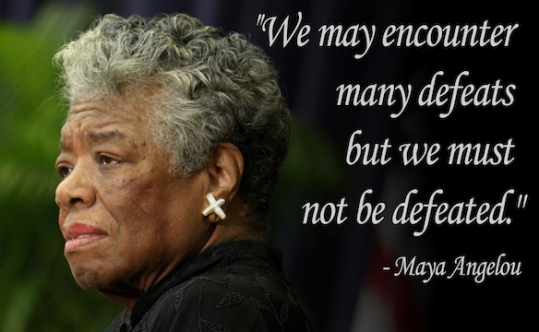
Maybe the most impressive author I ever had the chance to see was Maya Angelou—once at a teacher’s conference in Oakland and a second time at San Diego State University. I was shocked to hear when she passed away this year, just because after hearing her speak, it seemed as though she was one of those voices who would live forever. And what a voice—the most resonant, memorable, lyrical voice this side of James Earl Jones.

At SDSU, she did not just give a canned inspirational message, but it was as if it were a three-act play. She wove the story of her remarkable life—her difficult and abusive youth, her mastery of five languages, her time with Malcolm X and Martin Luther King Jr., her experiences living in Africa and the Middle East—with her message of hope and love. One moment she’d be telling of her time as San Francisco’s first African-American cable car conductor (at 14 years of age) and then break into a song. Before long she would be reciting the magnificent words of the poet Paul Laurence Dunbar. Every bit of it was seamless. I feel sad for anyone who never had the chance to hear her speak.

One Saturday in the spring of 2009, I drove frantically from a workshop I had given in San Diego, arriving at UCLA just in time to hear Ray Bradbury speak at UCLA’s annual Festival of Books. He was quite frail by that time and in a wheelchair, but still full of the fire that lead him to write such wonders as Dandelion Wine and Fahrenheit 451. He still decried what he perceived as the advance of the totalitarian state and yet charmed the crowd with stories of his life as a writer. He told the story of writing the bulk of Fahrenheit 451 in UCLA’s Powell Library, using their typewriters which they rented for 10 cents an hour. He managed to finish the book for $9.80.

At that same Festival of Books, I had the chance to see Mitch Albom (Tuesdays With Morey) interviewed by Frank McCourt (Angela’s Ashes, Tis, Teacher Man). If I die, I want to come back as Mitch Albom—I just wouldn’t spend as much time writing about dying and the afterlife. However, doing so has not hurt Mitch. His books have sold over 35 million copies. I love music, travel, and sports and Albom combined them all to advance his education, establish a career, and have the twenty-something experience of a lifetime.

He traveled across Europe, freelancing as a sportswriter and supporting himself by playing music along the way. At one point he settled for a time in a small, Greek village and became the town’s “piano man” at a favored local bar. I remember sitting and listening to this story and thinking “why would you ever leave?” Eventually though, he came home and in time became the lead sports columnist for the Detroit Free Press. Let’s see. Sportswriter in Detroit or musician in Greek village—and you picked Detroit??? On purpose??

He continued to play music, eventually forming a band called the Rock Bottom Remainders that included other notable writers such as Amy Tan, Stephen King, Dave Barry, Ridley Pearson, Barbara Kingsolver, and others. The group did charity gigs at various locations including once at a book-sellers convention where they were so well received that they were surprised to find themselves being called out for an encore. They were startled when a stranger joined them on stage and grabbed an extra guitar, a guy who had been backstage and who Mitch thought was a janitor. Turns out the “janitor” was Bruce Springsteen, who sat in with them for their final song and offered the advice, “Your band’s not too bad. It’s not too good either. Don’t let it get any better, otherwise you’ll just be another lousy band.”

Throughout the discussion with McCourt, he had the crowd in stitches. The guy could tell a story. Novelist, sportswriter, musician, traveler, comic and guy who hung out for one night with Bruce Springsteen. I would take that life in a minute–as long as I didn’t have to live in Detroit.

I also have been surprised at how willing authors are to correspond with their readers. I got the idea to have my students write to their favorite authors and ask them five questions and see just how many responses we would get. This was in the early 90’s, pre-email and pre-Google, so contact information was much harder to come by. Most got either form letters (Stephen King sends out form post cards) or no response, but I scored.

I wrote to Thomas Boswell, sportswriter for the Washington Post, because I had just read his fine collection of baseball essays, Heart of the Order. It bothers me greatly that I cannot find that letter to this day, but I still remember that he took time on New Year’s Day of that year (91-2?) to pen a two-page letter to a baseball fan/teacher with his answers to my questions about the life and work of a sportswriter.

And, of course, an autographed book is gold. Both of my kids became admirers of Barbara Kingsolver so with a little trial and error, I found out the method for getting a book to her for her autograph. In both cases I wrote a letter describing my appreciation of her work and my use of her books and essays as a teacher. I included personal notes about my kids and why they were devoted to the particular works that I was sending her. I found a first edition Poisonwood Bible at a used-book store to give to my son, Nico, for a Christmas present. I got it back from her in time and while it was duly autographed, there was nothing of the personal touch that I had hoped for.

I tried again, several years later, sending Kingsolver a copy of the tenth anniversary edition of The Bean Trees, with a note about my daughter Emily who adored the book. Emily, a frequent worrier (not sure where she got that from), had trouble getting to sleep often as she made her way through the turbulent years of high school, and I described to Kingsolver that she would often pick up The Bean Trees, which she had already read several times, and simply pick a spot and start reading and let the beautiful words and tender characters wash over her until she could let her mind rest and fall asleep. This time Kingsolver came through. Inscribed on the title page of the book, in her careful script, was the note that read: “Emily, from one insomniac to another, best wishes, congratulations—and courage for the road ahead. Barbara Kingsolver”.

I guess what I learned, is that authors aren’t magicians. They are hard-working people, many of whom are quite humble and who appreciate their audiences. Like many gifted people, they are sometimes surprised at their own talent and by the response that they get to the work that they do. They are frequently insecure and scared to death that the wonderful idea upon which they are now working, may be their last (not unlike bloggers).

If you have a favorite author, find an email or an address and drop them a line. You might be surprised by the response that you get.


“You F@#$%&* s Left Me Behind”—Abandoned in the Wilderness

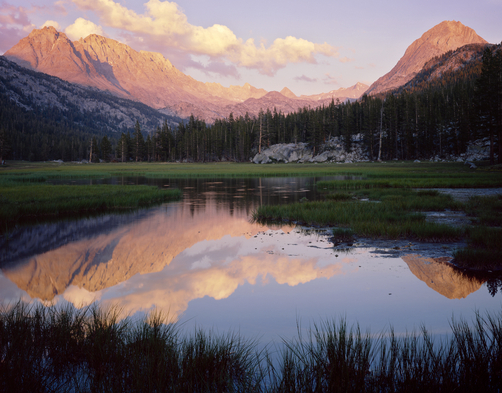
Mount Mendel, Mount Darwin and the Hermit, Evolution Valley, Kings Canyon National Park, Sierra Nevada, California


Note: Generally I avoid profanity in my posts, but some will show up in this piece in the interest of authentic dialogue.

As I mentioned in my last post, during my backpacking days, our group was dedicated to getting into Evolution Valley on the eastern side of the Sierras. The third time was the charm. Sort of.

It was Scott who spotted a shorter, but more difficult route to get there. It involved a relatively easy first day, a bruisingly difficult second day, and if all went well, we’d make the valley by lunch on the third day. But, once again, our well-rested enthusiasm while sitting around looking at maps in May overrode the reality of the trail we would face in August.

evol046


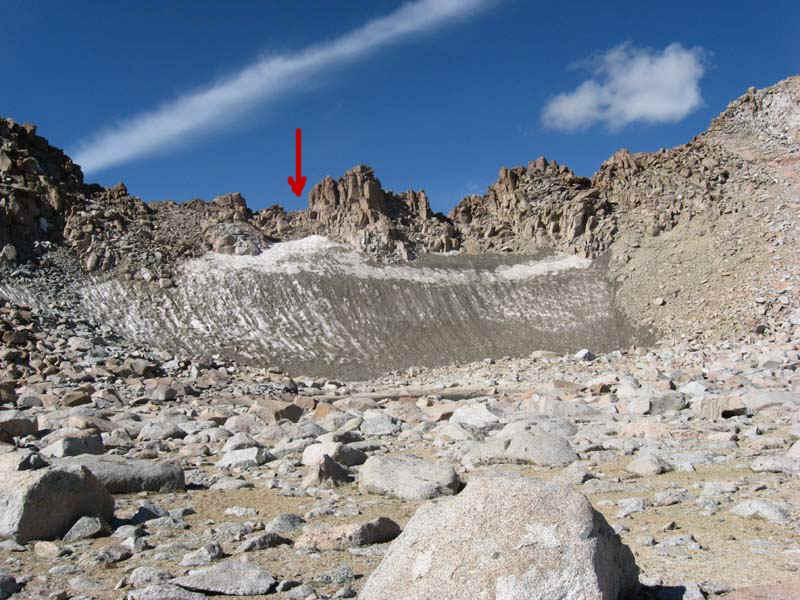
I was cursing Scott vigorously (in my mind) on that second day as I stood at the bottom of the steep incline that we knew from the beginning would be the backbreaker of the trip. We had spent the day threading our way to the base of the route that would ascend about one thousand feet over the course of a mile, a cross-country trail, meaning narrow and at times non-existent, with the last 500 feet being through a snow field. This would lead us over Lamarck Col (above), elevation 12,900 feet. A col is a small saddle or crossing that is not big enough to be considered a full-fledged pass.

There was nowhere to go but go up. It was one, slow, slog for me, and I had never been at this kind of elevation, had never made my body work this hard. The higher I got, the more it felt like my heart was going to burst alien-like from my body. I started to think of all of the good-byes I had not said to my loved ones before leaving on the trip.

As I hit the snow field, I didn’t think about anything except the headache and nausea I was feeling, my very first bout with altitude sickness. When I finally crested the top of the col, there was no elation. If possible, going down looked worse. The same one thousand feet, straight down, with no real trail, just a broken field of thigh-crushing boulders that I had to pick my way through and hope that every one I hit was solid and was not going to tip and launch me forward into oblivion.

We lunched at the bottom of this scree, knowing we had just gone through the worst part of the trip. There wasn’t much conversation, but Steve, generally acknowledged to be the smartest guy on the trip, said simply, “I’m not going over that again on the way out.” I think there was a collective sigh of relief that someone had had the brains to say what we all were thinking even if it meant a longer, more round about route back.

We camped that night near a chain of lakes in a spot known as Darwin Basin, feeling much better, knowing that tomorrow it would be all downhill where we would join up with the main trail that would take us to the friendly confines of Evolution Valley.

The four of us set off in good spirits the next day. We had studied the map and decided that our first stop would be where our current trail hit the main trail, having learned the lesson from my experience with getting lost to always plan for places to gather up after 1-2 hours of hiking to avoid losing track of anyone.

It should have worked. As usual, Harvey and Steve kept up a pretty brisk pace, and I settled comfortably back in the third spot with Scott taking his time and bringing up the rear. It was easy hiking and we soon were pretty spread out when I came to a fork in the road that had not been on the map. I looked for markers but there were none to be seen. Having looked at the map, I didn’t spend a lot of time agonizing over it. As long as I was headed downhill, I was going to intersect the main trail. The left fork looked more well worn so I opted to take it.

An hour later, I discovered I had chosen wisely. Steve and Harvey were resting comfortably at the trail junction, waiting for Scott and I. We figured Scott to be maybe 20 minutes back so we snacked and waited. And waited. And waited some more. We were puzzled, but not overly alarmed. Scott was experienced and the hike was easy, the trail, well marked.

But there was that fork in the road. After considering all of the possibilities, we decided that the most likely explanation was that Scott was the only one of us who had taken the right fork and had actually hit the main trail ahead of us and had likewise been waiting for us to show up, probably ½ mile closer to Evolution that we were.

We decided to forge ahead and see if we could catch up to him. The entrance to the valley was breathtaking. A wide stream ran down the center with steep ridges rising in the distance. By now it was late afternoon and Harvey, with his crazy, savant-like ability to sniff out a premier campsite suddenly veered off across the stream and found a nearly perfect spot—flat, protected, and possessed of a spectacular view.

We gratefully eased out of our packs and again considered the need to find our missing friend. Since I figured I owed him one, I volunteered to hike up the trail and see if he indeed had ended up ahead of us as we suspected.

Sure enough, less than a half-mile up the trail, on the opposite side of the stream Scott was comfortably set up in a campsite at least equal in beauty to the one I had just left. I called out a greeting, glad to be re-united with my friend, but he was anything but a “happy camper.”

“You fucking left me behind,” he said glaring at me.

“No way, Scott,” I tried to explain. “We waited for an hour. We could still be waiting and it wouldn’t have mattered. You came down to the trail ahead of us. If anything, you left us behind.”

But by now he had had a couple of hours to stew about this and had entered an alternative universe where logic had no place.

“You fuckers. I can’t believe you guys did this.”

I quit trying to convince him with logic and told him we were in a great site, less than twenty minutes back down the trail.

“No way. I like it here. I’m not moving.”

I saw there was no convincing him, so I told him I’d let the other guys know that I had found him and where he was set up and maybe we’d come up there and join him.

I shuttled back to Harvey and Steve, finding that they had begun to set up camp and while happy to know that Scott was safe had no interest in putting their packs back on and re-joining their disgruntled friend.

“Fuck him,” said Steve.

“Fuck him,” said Harvey.

I was torn, but tired of trying to be peacemaker.  “Fuck him if he can’t take a joke,” I said registering my vote.

So that night, in two campsites not twenty minutes apart, we separately enjoyed a peaceful evening, a gorgeous sunset, and a star-filled evening in what we had convinced ourselves was maybe one of the most beautiful spots on Earth.

After a leisurely morning, Harvey, Steve, and I packed up and headed up to Scott’s campsite. Scott, in better humor, renewed his list of the egregious wrongs we had done to him by abandoning him on the trail, but a night alone had completely changed his view of the event.

From that day forward, that night became “the best night of backpacking I have ever had.” He had savored the isolation, the quiet, living the experience of the valley without the distraction of his asshole friends.

To this very day, the story of this trip (if he is telling it) begins with “you fuckers left me behind” and ends with “best night ever.”