Senior Scrapbook: The Second Best Idea I Ever Stole

???????????????????????????????

During my 36 years as a high school English teacher, I generally substituted creative theft for actual creativity. Some of the best practices that I used were taken from teacher workshops, my colleagues, and journal articles. One of the things that teaching did for me was to keep me engaged in the world, always looking for something I might adapt and use effectively in the classroom. A song lyric, a news article, a documentary, a project my own children might bring home from school were all fair game. This was how I entered the weird world of scrapbooking.

I taught Advanced Placement (honors) senior English for the last 12 years of my career and all AP teachers, particularly those who worked with seniors, quietly dread the day that the AP test has come and gone. Beginning on the day that the students would return from the test for which I had prepared them, they would begin to look at me as some alien being, someone who no longer served any purpose especially when I would insist that we were continuing on with our work as usual.

I faced 4-5 weeks of trying to keep them engaged when nearly every kid had already chosen the college they would be attending the following year, and once AP tests were over, they were done. My best attempts were met, not with hostility, but with a deep and abiding sense of apathy. “Mr. Waldron,” they would say, “why do you keep trying to make us do stuff?”

 I did “stuff”, because I could not stand the boredom that comes from doing nothing. I decided they would read The Rocket Boys, the poignant memoir by Homer Hickam, popularized by the film October Sky. They would write a reflective essay focusing on one significant thing they had learned during their high school years, or to profile one special person who had provided them with mentoring and guidance. Students would also prepare a reflective speech to be delivered on one of the final three days of school. The guidelines were similar to the reflective essay and provided me with an easy way to get through the final three days with little to grade.

Lastly, they would create a scrapbook.

It started with the class of 2001. The entire idea of this four-part unit was to personalize the last 5 weeks and to give them opportunities to look back and consider what this experience of high school had meant to them, the good and the bad. For better or for worse, they were hitting one of our society’s significant rites of passage—graduation from high school. It was also designed to make the last 5 weeks as fun and easy for me as possible. Call it senior-citizenitis.

The seed of the idea for the scrapbook came from an article I read in the spring about a teacher who had used the creation of a scrapbook as a classroom activity. It occurred to me that this fit right in with my theme and that it would be both valuable and fun to have students create their own, individual scrapbooks, full of their best memories from high school.

I kept the guidelines simple. The scrapbook was to be a minimum of 25 pages. Each scrapbook had three required elements: a copy of their reflective essay, a short blurb on each section telling why this sport, activity, person, club, was significant, and three letters from meaningful people (a friend, a school person, and a relative) written to them and reflecting on this moment of their impending graduation. The other pages were up to them. I gave them a list of suggested page topics, but they literally exploded with ideas of their own. The grading was simple. If students met the requirements on time, they got full credit. The scrapbook could be expensive and elaborate with themed paper, stickers, and all of the other scrapbook madness, or it could be in a three-ring binder mounted on typing paper. It had to be completed at home. I took only three class days out to check on the number of completed pages and check on the required elements. The hardest part for me was getting through the class in one period. Some kids wanted to tell me the story behind every picture on every page and I really, really wanted to listen because some of them had worked so hard, but I had to sometimes rush them so I could look through all 30+ scrapbooks in one period.

I kept the same requirements for 12 years with very little adjustment, the biggest change being that after the first year, I told the students about the project during the first week of school to give them plenty of time to take pictures, save memorabilia, and to procrastinate. After the project had become well established, I would poll the students on the first day of school as to whether or not they had heard anything about it. Ninety percent of them had. Some of them had literally gotten into my class specifically because they wanted to do this one assignment. Wide-eyed kids eagerly told me that they already had completed some pages during the summer before their senior year had even begun. The finished projects ranged from meeting the minimum requirements to putting together 80-page productions in multiple volumes. It became a monster.

But it did not catch on right away with that very first class, the class of 2001. In fact, there was open revolt from the moment I suggested the idea. Remember, I introduced it with only 5 or 6 weeks remaining and it sounded like work and work was something that most had grown allergic to by then. But, there was a distinct gender split. As I explained the project, I could see a euphoric expression crossing the faces of some girls as if this was the assignment they had been waiting for, hoping desperately for, for their entire high school careers. Many of the boys were outraged. “You can’t make us do this“ they threatened. “We’re going to start a petition!” I’m not sure what the petition would have been for or to whom they would have given it, but clearly they needed some outlet to combat my audacity. One of the boys came to me and said defiantly, “I’m just not going to do this project!” My response had been honed by years of practice. I looked at him blandly and said, “You don’t have to. You don’t have to do anything I assign. If you can afford to lose the 100 points for the project, then don’t do it. It’s entirely up to you.” While the boys were planning rebellion, the girls were already planning scrapbooking parties.

We made it through that first year. The rebels surrendered and put their mothers and girlfriends to work and everyone completed the task. In the last weeks as I attended numerous senior activities, both kids and parents approached me to thank me. “We are so grateful that you made us do this. We would never have taken the time to do it on our own and now we have something really special to help us remember his high school years” was a comment I received frequently.

Alicia, a wonderful student from the class of 2005 wrote a message to me recently where she stated, “I found my scrapbook last summer and can’t thank you enough for creating an assignment for us to compile a concrete record of our time at Valhalla (High School). I never would have done it on my own, and it was incredible to rediscover the high school version of myself—so concerned with defining my own personality and path, surprisingly struggling with some of the societal and personal issues that I think about today.”

It’s funny the things that endure. I tripped across an article, adapted it for the classroom and decided to give it a shot. I quite unknowingly discovered a tool by which kids could “rediscover the high school version” of themselves. As the years have gone by and I have met up with or heard from students who are now scattered across the country, the scrapbook is invariably mentioned.

So much from the classroom fades away, but clearly, the scrapbook abides.



A Handshake A Day…A Classroom Practice That Changed Everything

601px-Handshake1.svg


During my 36 years of teaching English at the high school level, I attended many, many “professional development” workshops. I will let you in on a secret. By and large, teachers are terrible learners.

We demonstrate every bad behavior that we spend all day chastising our students about. We don’t pay attention. We pass notes. We ignore directions. We grade papers instead of attending to the presenter. Smartphones have made us even more inattentive, since now we can check email, Facebook, or chat with our friends across the room via text messages.

It is not our fault altogether. The workshops frequently do not meet our most critical or pressing needs. They are often planned by administrators who have lost touch with the classroom. And especially bad are the district-sponsored sessions that are designed to indoctrinate teachers into THE NEXT BIG, IMPORTANT THING IN EDUCATION which they are convinced we must begin to implement immediately. Those of us who have been around feel a touch of cynicism about such roll-outs because we know it is likely to be just a couple of years before we are dragged back into the same room to hear about THE NEXT BIG, IMPORTANT THING IN EDUCATION which not only replaces its predecessor, but likely undoes all of the work we just completed implementing for the previous program.

However, one spring afternoon our staff gathered for a half-day workshop with a focus on the importance of boosting students’ self-esteem. This was some time ago when caring about students as individuals was considered as important as producing good test-takers.

The woman presenter was earnest and sincere and I’m sure she gave us a lot of good ideas and strategies, all of which I have now forgotten—all except for one. She told us that she stood at the door of her classroom at the beginning of every period and shook hands with every entering student, greeting every student, every day.

She claimed it was the single most influential thing she had ever done in terms of creating a warmer and more welcoming classroom environment. She claimed that once she began, her problems with discipline were greatly reduced, her students felt better about her and about themselves and most remarkably, that she could wait until the end of the day to record her attendance because she could actually remember who had attended that day.

“Hmmm,” I thought. This actually sounded like something.

There were so many reasons NOT to try it. First of all, we were nearing the end of the year, with barely 6 weeks of school remaining. Introducing a new ritual, a new daily practice would be awkward, both for me and for them. My classroom had two entry doors, so I’d be unable to greet them coming in the door. I’d need to wait until they were seated and then circulate through the room killing more instructional time. Most of all though, the thought of it made me feel vulnerable. I imagined that the kids would think it strange, forced, artificial. I convinced myself several times to put it off to the beginning of the next year. After all, it would be so much easier to start off the year with a brand new group of kids who had no expectations, who would be less likely to see this new practice as being a weird departure from the norm.

But the idea gnawed at me all weekend. If it was really that good, if it really made that big a difference, why not take it on a test drive for 6 weeks and see if it really could have the kind of impact that the presenter had suggested?

I was nervous on Monday morning. The first period kids sat down at the bell, and I began circulating up and down the rows with my first official handshake of what would become a ritual that would endure throughout the rest of my career. Students were surprised, puzzled, skeptical, and amused as I went around greeting each kid briefly. Once I was done, I certainly had their attention because they all wanted to know what the heck that was all about. So, I told them the story of the workshop, of my decision to experiment with them until the end of the year. After we had given it a try, I told them, I’d let them tell me what they thought, whether it was something I should continue with or not.

Over the next couple of weeks, we all became used to the new ritual. I began to look forward to this way of beginning each class. I liked that I had a brief moment each day to acknowledge every student in my classes. If I had a concern with one of the kids, I could pause at his desk and consult with him for a moment. Likewise, the students discovered that this was a good time to stop me if they had a particular problem or question to which they wanted to alert me. I found myself giving impromptu handshake lessons when students would offer up what I called a “dead fish handshake”, letting their hand lie limply and passively in mine. I felt like I was performing a public service by preparing them for using the proper “business handshake” that they would need as they eventually made their way into college and job interviews.

As the year came to a close, I did not feel as though I had seen a huge transformation in the classroom atmosphere. I had, however, begun to feel a significant change in me. By spending that moment every day with every student, I began to be much more aware of the uniqueness of each kid. Especially important to me was that it gave me a chance to chat with and acknowledge those who were very quiet or shy. They couldn’t hide when I was standing over them with my hand outstretched and, over time, I think they appreciated the attention.

During finals I surveyed the class and asked them how they had felt about our little experiment. It had become so routine by then a lot of them shrugged their shoulders. “Fine” some of them mumbled. One brave soul raised his hand to comment, “What I noticed, Mr. Waldron, was that it was really hard to be mean to you when you took time to shake our hands every day.”

Well, that was enough of an endorsement for me. I continued shaking hands for the next 15+ years, every kid, every day. Through it, I discovered not only the importance of creating a non-threatening physical connection, but the importance of having unique classroom rituals. The handshake made our classroom special because no one else (that they knew of) was doing it. Howls would go up if I mistakenly tried to begin class without handshakes first. Returning student might not remember a single thing I had taught them about reading or writing, but everyone remembered our daily routine.

One student who wrote to me on the occasion of my retirement in 2012 summarized it nicely: “I remember your daily handshakes (or fistbumps if we were sick) like it was yesterday. Taking those few minutes out of your day to talk to each student really made a difference, especially during a time where every teenager is struggling to figure out who they are and where they fit in. It was nice to know that at least one teacher really cared enough to take those few seconds out of their day to treat each student like a real person, not just another face in a crowd.”

Just a few minutes a day. Such a simple thing. I’m so glad I was paying attention during that one afternoon workshop so many years ago.

I Like Myself Just The Way I Am–Except For This One Thing

willpower

I imagine that the issue of New Year’s resolutions has been blogged to death and dropping another on you after February 1 is probably bad form, but I have my reasons.

The delay was due in part to the lingering effects of a bad cold and severe case of post-traumatic holiday syndrome. I was literally paralyzed for a week once the dust settled trying to sort through my feelings about this time of celebration and all of its attendant disappointments, unfulfilled expectations, guilt, and family drama. Don’t get me wrong, there were some very nice moments, and it’s always lovely to get to spend time with my adult children, but it was about one week into January when I exhaled, not realizing I had been holding my breath since November.

But I smugly began the new year with a leg up on most “resolvers,” those who make resolutions that they will not only not fulfill but if asked a year later won’t even remember what they resolved in the first place!

The remembering has never been a problem for me because I’ve had the same three resolutions for years: exercise consistently, lose some weight, write more. It just so happens that I achieved all of those goals this past year for the very first time. It is a rare day that goes by that I don’t get out for my 3-mile walk, or hit the gym for a swim, or spend an hour doing yoga. A direct result has been that I have dropped about 8 pounds, regained a notch on my belt and now fit into some clothes that I was about ready to donate so they would not spend all of their time taunting me from the depths of the closet. Then, beginning this blog in March provided the inspiration to produce 25,000 words, give or take, neatly packaged into 20 distinct articles.

The most shocking part for me about the writing is that I actually have readers, to whom I am grateful beyond belief. Thanks to the info that WordPress keeps, I even know where in the world my readers are primarily located. It turns out that there is group of crazy Brazilians who frequently read my stuff. And I want to know who you people are so please, drop me a comment and let me know why you don’t have something better to do than follow this blog!

However, no matter the self-righteousness that I feel I have earned over the past year, I also feel compelled to tell you that I do have a resolution for 2015. It’s a secret. Please don’t tell anyone about it. I am not confident at all that I will make a dent in this one.

beers

Truth be told, I like to drink beer. I like to drink more beer, more often than some of my relations, my doctors, and conventional wisdom think is appropriate. Since it gives me pleasure, I know instinctively that it must be bad for me and that I should cut back. Cutting back, I have found, is hard. In fact, I suspect I would have better luck giving up alcohol altogether than to try to be consistently moderate. Being moderate just sucks. However, cutting back is my resolution for 2015.

Let’s face it. Medically, it makes all the sense in the world to reduce my alcohol consumption. Anything that can eventually destroy my liver is a bad thing. However, I have gotten very mixed signals from my doctors when we have talked about this. My GP suggests “just one or two per night” but then warns me not to cut it out altogether because it could adversely affect my blood pressure. My therapist said to quit worrying about it, that at the level I was drinking if I were to cut off a couple years of my life they’d be the worst couple of years of my life anyway (I like him). A cardiologist I met with gave me a fish-eyed look and said “one.” He looked like a man who took pleasure in taking away the pleasures of other and instinctively I did not trust him. One final health professional confided in me that actually 3 or 4 drinks is now considered “moderate” but that no doctor will actually tell that to his patients (I like him).

So I need an additional motivation. Not wanting to be a slender guy with a prodigious beer belly is certainly one of them. At 150 calories per 12 oz bottle of premium beer, consuming an extra 300 or so calories per night must mean I’m in a constant battle to maintain my weight, right? But, in fact, I’m not. I’m very conscientious about my diet and I exercise religiously. As I have looked for beer substitutes, something to sip on that will be satisfying, tasty, but not alcoholic, I discovered that virtually all of them have just as many calories and many throw in the evils of processed sugar and caffeine. If it’s not water, it’s not a good trade-off. Also when I have given up beer for a week at a time and maintained all of my other good habits, I expect the pounds to just absolutely fall off of me. I want to see my weight drop at least one pound a day to compensate for the pain of abstinence. It just doesn’t seem to work that way.

And there is the WTF factor. I do not live each day to the fullest and in fact, I don’t think anyone actually does. Many days are full of trips to Target and the dry cleaners. Others to grocery shopping, cleaning and paying bills. It’s just life, and I’ve been lucky to have enjoyed an awfully good one for 62 years. On my way to the sports section, I can’t help but glance at the obituaries and take ghoulish pleasure in the growing numbers of complete strangers that I have outlived.

Sadly, I have also lost former students, friends, and colleagues who died far too young, taken by accident and disease. I’ve seen young friends felled by stroke and brain tumors. Being aware of life’s capriciousness has not exactly made me fatalistic, but what the fuck? Knowing that I can get taken down by some kind of heinous disease at any moment, I’m less inclined to follow the arbitrary rules of healthy beer consumption. Besides, it tastes good—really good.

And, it feels good to be a little bit bad. I was an altar boy as a young man, a fanatic rule-follower. I don’t think I knowingly broke a rule until I was 34. I am the guy who will stop for a red light at a crossroads in the middle of the desert at three in the morning, waiting for the light to turn green. To my great frustration, I will not allow myself to commit adultery even in my in my dreams (“Gosh, sorry, ma’am. I’m awfully flattered, but it just wouldn’t be right, me being married and all. I hope you can understand”). An extra beer at night feels like a small revolution, a salute to independence, a raised middle finger to all of the conventions I have followed for so long.

And there is an illusory effect that beer has on me that all experiences are enhanced by drinking. Television is better, music is more profound, the book I’m reading is more moving when accompanied with my favorite IPA. I am absolutely certain that the sunset is more vivid, the moonrise more spectacular, and that the fire is warmer and more captivating sitting outside by my outdoor firepit welcoming the night with a cold one. Likewise, when writing, the words seem flow more easily, my mind races with ideas, synapses are firing that I didn’t know existed, and at times I’m convinced I’m pouring out nothing but brilliance as I sip on my drink. This is before I humbly proofread my work the next day in the very sober light of the following morning.

These are all of the reasons that I will fail miserably with my one resolution for 2015. Here is the reason I will succeed.

I like to feel good when I wake up in the morning. I like to wake up and lie in bed planning out my day without a dull headache, a hazy memory, and a rumbling stomach. When I get up in the morning after a non-drinking night, I feel cleansed and righteous. I feel the same way I used to walking out of the confessional as a youngster knowing that my sins (which were nothing close to sins at all) had all been washed away. I feel more alert and have more energy as my day begins with that glow of well-being filling my soul.

We will see, in 11 months, if that is enough to turn the course of a deeply-rooted habit–a habit I really enjoy. Not giving it up, mind you. Just cutting back.


“Just Dropped In to See What Condition My Condition Was In”

depression-anxiety

Note:  Thanks to Kenny Rogers and the First Edition for the title (you have to go way back to know that one!)


Of course I’m depressed. I mean, who wouldn’t be. Ebola, climate change, Supreme Court decisions, police injustice, terrible things going on in Syria, Iraq, and Iran. There are days that I have to avoid the front section of the newspaper altogether. I withdraw to the sports section where I can be comforted by the complete meaninglessness of whether or not the Sixers will win more than one game this year, or court the anxiety of my Chargers trying to stagger, once again, into the playoffs, and ponder if the Padres are about to make yet another horrible trade.

On my worst days, I figure that anyone who is not depressed is just not paying attention.

And this is one aspect of me that drives my wife just a little crazy. After all, I don’t actually have Ebola. Like most Americans, I have little say over the direction of the country, and people much smarter than me have failed miserably to guide events in the Middle East. No one at the Padres or Chargers seems much interested in my advice as sound as it might be.

Instead, right at this very moment, I’m writing as I sit out on my deck, drinking a beer, and enjoying a lovely, San Diego sunset. I am in reasonably good health. I’m retired which means I don’t have to do anything on a given day, although I do enjoy substitute teaching occasionally, attending adult school classes, hiking, taking long walks, reading, writing, doing yoga, swimming, traveling, and gardening.

In other words, from the outside, it would seem that I have no good reason to be depressed. I have no good reason to be anxious.

And yet, I do get anxious. I still slip into depressive periods. I start to see every setback as a personal failure. The car breaks down and in my mind, it spirals into a catastrophe. I make a simple mistake on a project and I curse myself as an “idiot.” I get disoriented in an airport, and I start to panic. How come everyone else knows where they are going? I am a sponge for other people’s sadness and for the troubles I see in the world. I get a headache, I worry about brain tumors.

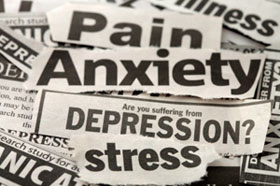
I’ve been seeing a therapist for depression and anxiety for over ten years now. I was encouraged to seek out help because I kept slipping into depressive episodes as I became overwhelmed with work (an almost constant condition for a teacher), and because I noticed how I increasingly reacted to everything and everyone negatively, sarcastically. I resisted for quite a few years, but now I take medication to even out the highs and the lows. The sessions were frequent at the beginning. Now, I go in every couple of months, just to check in, just to make sure that I’m still moving in a positive direction.

It’s not something that I share lightly, but also something I’m not afraid to share especially with my former students who from time to time have in the past, and still today, seek me out in times of distress.

I came to know early on in my teaching experience, just now little I knew about the lives of my students as I interacted with them for my 54 minutes per day. If I saw a kid obviously in distress, I would take him aside and offer support and give him a chance to talk. Some students welcomed the attention. An equal number resented the intrusion.

Others were in pain so close to the surface, that the slightest interaction was enough to cause them to open up. One girl came in after school, ostensibly to talk about a problem with writing, and promptly dissolved into tears. What she really needed was to talk to someone about her mother who was creating chaos in her life. I once teased a young woman about the baseball cap she was wearing, whereupon she burst into tears. I took her aside and we spent the next two hours (and a good chunk of the following year) talking about the very painful break-up she was experiencing with her first boyfriend.

Just last week, helping a former student finish her college essays, we ended up talking about the pressure she was feeling from her parents, how she often felt isolated, how she felt guilty about moments of enjoyment, about how she felt somehow she didn’t deserve to be happy.

All three of these students were young, vibrant, bright, engaged young women. They were all high achievers who expected much of themselves. All three had a very hard time seeing beyond their present crisis or beyond their present way of thinking about it.

Somewhere in my conversations with all of them, I brought up my experience with therapy, with having to seek out some support, with how I came to realize that I needed professional help. Invariably, my students are surprised by this because the impression I give to my students when I am in front of a classroom, is that I am a positive, happy, high-energy person. They come to assume that I am like that all the time. What they didn’t know was that persona would pretty much collapse after 6th period on any given day.

Like these three young women, before therapy, I didn’t have strategies to cope with outside forces that I couldn’t control. I couldn’t understand why I didn’t quickly bounce back from the debilitating pain of loss. I often felt like a fraud and was incapable of accepting a compliment gracefully.

The most startling part of entering therapy was discovering how normal I was. I still remember in the first few sessions, as I started to describe the thoughts that plagued me, as I unburdened myself of all of the stuff I had been carrying around with me for so long, how utterly unimpressed my therapist was. “Yeah.” he responded. “You have a number of what we call “cognitive distortions” which is just a fancy way of saying that over time, you’ve come to distort the way you look at yourself and the world around you. You’re not an idiot, every setback is not a crisis, lots of people get lost in airports, and you probably don’t have a brain tumor.”

Then he handed me a list of “Common Cognitive Distortions”. There were 15 of them. They had neat little labels. The situations I had described fit nicely into 5 or 6 of the categories and I could see hints of how I perceived the world in 4 or 5 more.

I felt a little deflated. I thought I had really serious issues and here they were all boiled down into nice little boxes, all described on a single sheet of paper. I wasn’t anguished after all; I was mundane.

That last sentence is an example of a cognitive distortion. I just can’t remember which one right now.

Of course, my concerns and the pain I felt were real. The work it took to begin to recognize and respond to years of perceiving myself negatively was hard, and I have had to learn some lessons over and over again. The ruts in my ways of thinking are deep and even now, I fall back into them. That’s why the check-ups continue to this day.

I certainly do not share all of this with my students who are in distress. What I mostly do is listen to their concerns, share similar experiences that I have had, and most especially make sure there is help and support available to them. If I feel they might need the help of a professional, I try to demystify that experience for them. It’s amazing how comforted they seem to feel to know that a trusted adult has also struggled, has sought out professional help, is still working on personal issues that are not always all that different from their own.

If anything, I try to help them to feel normal again, to feel mundane—but in a good way.


Hating the Heat

11988336_10153180168067339_6951574592152882575_n

This is a re-post of one I wrote last September.  The heat is back.  Time to share the misery once again.

Living in Southern California (San Diego, specifically) leaves me so little to complain about when it comes to seasonal weather that it is downright discouraging.

I mean, how can I complain to people from the rest of the nation who year after year live through blizzards, followed by “mud season”, the spawning of Mosquitos of Unusual Size, and locusts for all that I know. Outside of my SoCal bubble, there seems to be a brief period of lovely spring-like weather followed by monsoonal storms, and then tornados, blistering summer heat, and mind-numbing humidity. I hear fall is nice, but can the beauty of fall colors get a person through the inevitable knowledge that the blizzards are on the way once again?

I get it. Even throwing in our occasional earthquakes and wildfires, my meteorological complaints can’t compare to those of the average Nebraskan or Upper Peninsula Michigander.

However, as the climate changes, a fact universally acknowledged by any everyone except the 30% of Americans who get all of their wisdom and opinions from Fox News, summers are getting longer, hotter, and more miserable here in paradise. For me, it means longer periods of frayed nerves, slothfulness, and despair.

If you aren’t from around here and you keep an eye on the weather pages, you might regularly curse the seemingly endless reports from San Diego of temperatures that never exceed 85 degrees. Please understand that those temps are being recorded on the coast, in the shade, and I suspect, in an air-conditioned room, so that San Diego will have an endless appeal to tourists. Each mile inland from that thermometer means a one degree increase in temperature, so that in my corner of the county, 85 on the coast usually means 100 degrees in my inland valley. The thermometer seems to be stuck there for long stretches from June through the middle of November. It is becoming increasingly popular to plan Thanksgiving as an outdoor picnic.

I try to adjust. I really do. I get up earlier, get my walk done before the worst of the heat begins or take late evening walks. I blow through my outdoor chores sometimes as the sun is just coming up. As soon as the sun goes down, if the heat has not beaten the life out of me, I try to enjoy the warmly comfortable evening out on my deck or at a nearby bar that features an outdoor, big-screen TV with endless sports coverage.

As summer comes on, I become obsessed by the daily forecasts. None of them accurately anticipates the suffering I’m going to feel the next day. I recently bought a digital indoor/outdoor thermometer so that I continually, throughout the day, can check the exact temperature so that I know EXACTLY how miserable I am and EXACTLY how much I should be able to complain about it. My family has grown weary of my constant updates as the heat climbs toward triple digits.

My self-esteem sinks on days like this as my motivation to accomplish anything wanes. Sweeping out the garage seems like a monumental task. Watering the roses?—Herculean. I stare at the phone but the idea of actually picking it up to make an appointment to have my car serviced is just too much. On such a day, can’t watching 5 episodes of Scandal be considered an accomplishment? My lethargy weighs on me.

Essayist Joan Didion described this phenomenon brilliantly in her essay on the effects of the Santa Ana winds, a weather condition that brings high temperatures and hot, dry winds howling through the inland valleys, frequently in September and October when the tips of the palm trees turn brown and we start to hope for fall. It’s good to read her words and know that my desperation at day-after-day heat is not isolated. She recounts the effects as the populace senses the onset of the super-heated winds: “The baby frets. The maid sulks. I rekindle a waning argument with the telephone company, then cut my losses and lie down, given over to whatever is in the air.” She further quotes Raymond Chandler who wrote about the winds saying, “On nights like that every booze party ends in a fight. Meek little wives feel the edge of the carving knife and study their husbands’ necks. Anything can happen.”

It gives me comfort to know that external forces are toying with my actions and emotions. I know that I will rise again once our three weeks of winter begin some time in January. Until then, I wait in quiet desperation for the sun to go down. I give thanks for Netflix. I lie in bed at night waiting for the first cool breeze of the day to come drifting in my window, listening to the sirens wailing and the coyotes singing in the canyons.


Walking (…and walking, and walking some more)

About 10 weeks ago, I became a man on a mission. I decided, come rain or shine (an easy promise given that it rains about 3 teaspoons a year here in San Diego), I would take a vigorous walk for a full hour each day. It turns out that at the pace I walk, I end up putting in a bit over 3 miles in that hour.

I became motivated by a visit to a cardiologist after I was diagnosed with atrial fibrillation, or A-fib, which means that occasionally (turns out to be very occasionally) I get rapid and irregular heartbeats. It’s one of those conditions where the doctor tries to be reassuring and threatening at the same time. “Lots of people have it, and we’re not sure what causes it exactly, and by itself it’s not particularly harmful, except that it could possibly cause a stroke that could kill you.”

Huh. Well one symptom it causes is that I’m suddenly aware that there are dozens of TV commercials for medications for people with A-fib (mostly blood thinners) that show people my age being happy, healthy, and active while the voice-over cheerfully recounts the dangers of A-fib and the equally damaging potential side effects of the wonder drug they are hawking. I never noticed these ads before.

So, to stop the stroke that I might get if I continue to have fits of A-fib which might or might not happen, doc wants me to reduce caffeine intake (to 8 ounces daily), my beer consumption to no more than one a day, and to increase exercise.

Eight ounces of coffee is not even enough to start my heart in the morning. I have a 20 ounce cup of coffee from Starbucks every morning and 0 caffeine the rest of the day. To ease into the reduction, I now ask for “room for crème” when they remember to ask. I figure that cuts two to three ounces. Hey, it’s a start. I’ve cut my beer consumption by about 20%, and I figure I’ll get to his limit around the time it just becomes too hard to get out of my chair to get a second one in the evening.

So as much as I tend to respect authority figures, I refuse to let them take away my reasons for living. To paraphrase Mark Twain, it’s important to cultivate some bad habits so you’ve got something to give up when you contract something really serious.

However, I have embraced “the walk.” It is one of my favorite times of the day. Because I have a high tolerance for boredom, I take virtually the same walk every day. I drop down from my street into a nearby neighborhood and fall into a loop that my wife and I discovered years ago, and make that circuit five times. I return home sweaty and feeling self-righteous. It is often the hour that goes by the fastest every day.

There are a multitude of things that keep it from being the “same walk every day.” Knowing that the sidewalk and street is banked, I decided one day to reverse course after three laps and walk the route in the opposite way. I discovered it was (for a while) an entirely different walk! Nothing looked the same. All of my familiar markers were gone. I nearly missed one of the turns because everything looked so different.

And then there are the people.

I have walked as early as 4:30 AM (insomnia is a great way to get an early start) and as late as 10 PM and everywhere in between, and I’ve discovered my route has patterns and rhythms that are as compulsive as I am. At that early morning hour, the soul of the street is dead. I was completely alone for a full hour and missed the camaraderie of the people I’ve come to know.

I’ve begun to feel like the unofficial mayor of “the loop.” People I don’t know smile and wave at me as they drive by. A nice, retired couple that I have spoken with several times asked if I’d “keep an eye on the house” for them when they were leaving on a long RV vacation. I helped calm some commotion at one end of the street when a lady discovered a snake peeking its head from a lawn drain and was frantically keeping people away. I took a look at it and reassured her it was a harmless king snake and nothing to worry about (sure hope I was right). I’ve stopped to help a lady load up a file cabinet into her truck and then guided someone who was having some trouble parallel parking a gigantic truck.

Over time, some individuals are becoming more distinct to me. Since summer hit, I miss the harried parents who are stuffing their children into the car to get them to school. The kids are amazingly friendly and enjoy greeting me and clearly have not been taught about the dangers of talking to strange men. If I walk a little later in the morning, I am likely to see Spring Valley Dude emerge, usually on his phone, dressed only in a swimsuit with long scraggly hair smoking a cigarette, trying to get over his hangover from the night before. I always stop to trade gardening tips with Tera if she is out working in the front yard vegetable garden that she and her husband built, creating 6 raised beds for a wonderful growing space. I sometimes cross the street if I see this young, intense walker headed my way. He moves very slowly and wears way too much clothing for the hot weather we are in, and smokes while he walks. I’m pretty sure he is a serial killer.

I’m sure in another 5 or 6 months, I’ll start to get bored and either change the route or start having to drive somewhere to vary my routine. However, I’m terribly habitual and in this case my habit is making me healthier. Besides, my people need me. I have to keep an eye on things for them, help them park, save them from snakes, and keep an eye out for serial killers. I take my responsibilities seriously, especially the ones I don’t really have.

“You F@#$%&* s Left Me Behind”—Abandoned in the Wilderness

Mount Mendel, Mount Darwin and the Hermit, Evolution Valley, Kings Canyon National Park, Sierra Nevada, California


Note: Generally I avoid profanity in my posts, but some will show up in this piece in the interest of authentic dialogue.

As I mentioned in my last post, during my backpacking days, our group was dedicated to getting into Evolution Valley on the eastern side of the Sierras. The third time was the charm. Sort of.

It was Scott who spotted a shorter, but more difficult route to get there. It involved a relatively easy first day, a bruisingly difficult second day, and if all went well, we’d make the valley by lunch on the third day. But, once again, our well-rested enthusiasm while sitting around looking at maps in May overrode the reality of the trail we would face in August.

evol046


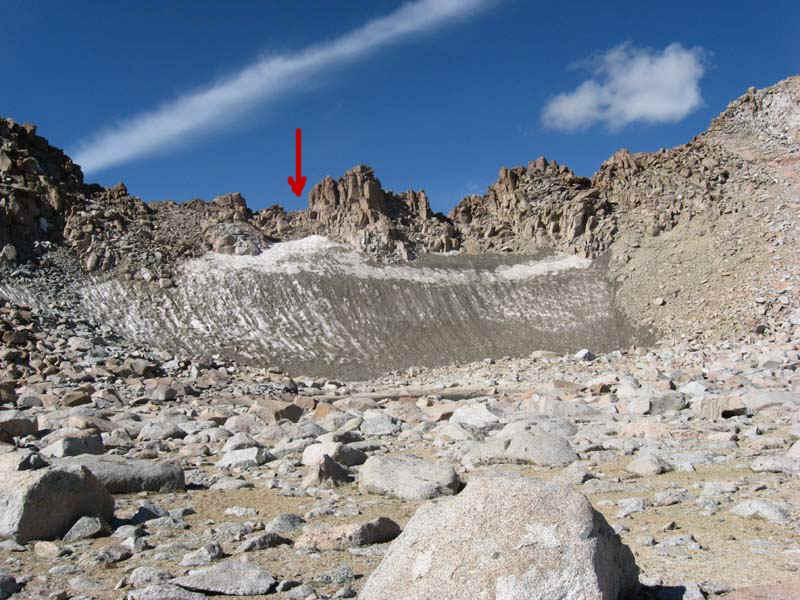
I was cursing Scott vigorously (in my mind) on that second day as I stood at the bottom of the steep incline that we knew from the beginning would be the backbreaker of the trip. We had spent the day threading our way to the base of the route that would ascend about one thousand feet over the course of a mile, a cross-country trail, meaning narrow and at times non-existent, with the last 500 feet being through a snow field. This would lead us over Lamarck Col (above), elevation 12,900 feet. A col is a small saddle or crossing that is not big enough to be considered a full-fledged pass.

There was nowhere to go but go up. It was one, slow, slog for me, and I had never been at this kind of elevation, had never made my body work this hard. The higher I got, the more it felt like my heart was going to burst alien-like from my body. I started to think of all of the good-byes I had not said to my loved ones before leaving on the trip.

As I hit the snow field, I didn’t think about anything except the headache and nausea I was feeling, my very first bout with altitude sickness. When I finally crested the top of the col, there was no elation. If possible, going down looked worse. The same one thousand feet, straight down, with no real trail, just a broken field of thigh-crushing boulders that I had to pick my way through and hope that every one I hit was solid and was not going to tip and launch me forward into oblivion.

We lunched at the bottom of this scree, knowing we had just gone through the worst part of the trip. There wasn’t much conversation, but Steve, generally acknowledged to be the smartest guy on the trip, said simply, “I’m not going over that again on the way out.” I think there was a collective sigh of relief that someone had had the brains to say what we all were thinking even if it meant a longer, more round about route back.

We camped that night near a chain of lakes in a spot known as Darwin Basin, feeling much better, knowing that tomorrow it would be all downhill where we would join up with the main trail that would take us to the friendly confines of Evolution Valley.

The four of us set off in good spirits the next day. We had studied the map and decided that our first stop would be where our current trail hit the main trail, having learned the lesson from my experience with getting lost to always plan for places to gather up after 1-2 hours of hiking to avoid losing track of anyone.

It should have worked. As usual, Harvey and Steve kept up a pretty brisk pace, and I settled comfortably back in the third spot with Scott taking his time and bringing up the rear. It was easy hiking and we soon were pretty spread out when I came to a fork in the road that had not been on the map. I looked for markers but there were none to be seen. Having looked at the map, I didn’t spend a lot of time agonizing over it. As long as I was headed downhill, I was going to intersect the main trail. The left fork looked more well worn so I opted to take it.

An hour later, I discovered I had chosen wisely. Steve and Harvey were resting comfortably at the trail junction, waiting for Scott and I. We figured Scott to be maybe 20 minutes back so we snacked and waited. And waited. And waited some more. We were puzzled, but not overly alarmed. Scott was experienced and the hike was easy, the trail, well marked.

But there was that fork in the road. After considering all of the possibilities, we decided that the most likely explanation was that Scott was the only one of us who had taken the right fork and had actually hit the main trail ahead of us and had likewise been waiting for us to show up, probably ½ mile closer to Evolution that we were.

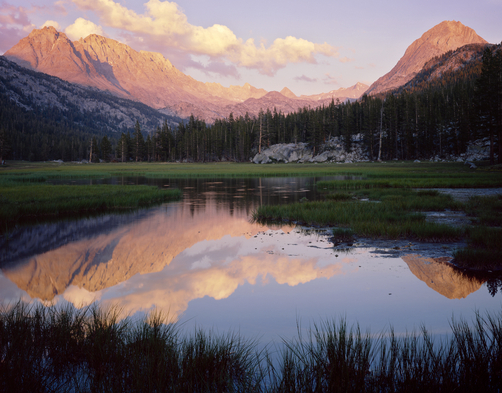
We decided to forge ahead and see if we could catch up to him. The entrance to the valley was breathtaking. A wide stream ran down the center with steep ridges rising in the distance. By now it was late afternoon and Harvey, with his crazy, savant-like ability to sniff out a premier campsite suddenly veered off across the stream and found a nearly perfect spot—flat, protected, and possessed of a spectacular view.

We gratefully eased out of our packs and again considered the need to find our missing friend. Since I figured I owed him one, I volunteered to hike up the trail and see if he indeed had ended up ahead of us as we suspected.

Sure enough, less than a half-mile up the trail, on the opposite side of the stream Scott was comfortably set up in a campsite at least equal in beauty to the one I had just left. I called out a greeting, glad to be re-united with my friend, but he was anything but a “happy camper.”

“You fucking left me behind,” he said glaring at me.

“No way, Scott,” I tried to explain. “We waited for an hour. We could still be waiting and it wouldn’t have mattered. You came down to the trail ahead of us. If anything, you left us behind.”

But by now he had had a couple of hours to stew about this and had entered an alternative universe where logic had no place.

“You fuckers. I can’t believe you guys did this.”

I quit trying to convince him with logic and told him we were in a great site, less than twenty minutes back down the trail.

“No way. I like it here. I’m not moving.”

I saw there was no convincing him, so I told him I’d let the other guys know that I had found him and where he was set up and maybe we’d come up there and join him.

I shuttled back to Harvey and Steve, finding that they had begun to set up camp and while happy to know that Scott was safe had no interest in putting their packs back on and re-joining their disgruntled friend.

“Fuck him,” said Steve.

“Fuck him,” said Harvey.

I was torn, but tired of trying to be peacemaker.  “Fuck him if he can’t take a joke,” I said registering my vote.

So that night, in two campsites not twenty minutes apart, we separately enjoyed a peaceful evening, a gorgeous sunset, and a star-filled evening in what we had convinced ourselves was maybe one of the most beautiful spots on Earth.

After a leisurely morning, Harvey, Steve, and I packed up and headed up to Scott’s campsite. Scott, in better humor, renewed his list of the egregious wrongs we had done to him by abandoning him on the trail, but a night alone had completely changed his view of the event.

From that day forward, that night became “the best night of backpacking I have ever had.” He had savored the isolation, the quiet, living the experience of the valley without the distraction of his asshole friends.

To this very day, the story of this trip (if he is telling it) begins with “you fuckers left me behind” and ends with “best night ever.”


Texting: Proceed With Caution

Text-Fails-11


When I taught a short story elective, I loved using Dorothy Parker’s wickedly satirical story “A Telephone Call.”  It’s a wonderful example of the use of internal monologue as a (more than) slightly obsessed young woman literally waits by the phone, expecting a call from a young man that she is apparently dating.  Published around 1930, I had to build some context for the students.  Yes, phones used to have dials. Yes, women used to wait for men to call first.  At the time, it was considered forward and inappropriate for a woman to be perceived as the aggressor—to take the initiative in a relationship.  They honestly looked at me as if I had somehow slipped into a foreign language.

The young woman in the story dramatically ponders every encounter she has had with the man and every word he has said to her previously as she tries to convince herself that the man’s tardy phone call is no reason for alarm:

This is the last time I’ll look at the clock. I will not look at it again. It’s ten minutes past seven. He said he would telephone at five o’clock. “I’ll call you at five, darling.” I think that’s where he said “darling.” I’m almost sure he said it there. I know he called me “darling” twice, and the other time was when he said good-by. “Good-by, darling.” He was busy, and he can’t say much in the office, but he called me “darling” twice.

Upon finishing the reading, the class was quick to claim that she was simply crazy, obsessed, ridiculous.

“Wait a minute,” I said. “Do you mean to tell me that you’ve never gotten a note, or a message, or a text and spent considerable time reading and re-reading it, trying to guess at exactly what the person’s intent and tone was?”

“Ooooh, yeah,” they laughed.  Virtually all of them had stories of messages about which they had obsessed–the more important the person, the greater the examination and analysis.

I am not immune from this. However, my first experience was when my bride-to-be and I dated long distance for two years during the early 1970’s.  We depended on the U.S. mail almost exclusively, writing each other two or three letters a week.  For me, each trip to the mailbox was full of sweet anticipation.  How would she have responded to my most recent verbal advances?  Would there be some vague promise of greater intimacy that would keep me entirely on edge until I could see her over the weekend?  Exactly how would she sign it?  Was “thinking of you” better than “love you” or a generic “see you this weekend” or the ambiguous “luv ya!” ( I mean, really, what does that mean?).

I saved most of these letters and occasionally I’ll grab one, in part to examine the artifact of the 7¢ stamp, but more to enjoy suddenly being cast back 40 years into my past, swept up by the youthful enthusiasm of a first love, feeling caressed by the warm words of affection that have lost none of their impact over the years.

I don’t bemoan the advances in technology or long for the time when one had to wait days for a loved one to receive a letter or to get a response, but I have discovered great dangers in the instantaneosity (I just made up that word) of our communication.

Lots of people struggle with this transition.  I remember when phone message machines first gained popularity and almost every message I got began with “Oh, gosh, I just hate talking to these machines!”  At least for me, that changed pretty quickly to feeling disturbed and a little betrayed when a person actually answered his phone when all I wanted to do was to leave a quick message and wasn’t mentally prepared for all the social niceties that go along with an entire phone call.

Texting has taken this dynamic to a whole new level.  In talking with my former students, especially those involved in some kind of romantic relationship, texting seems to be the primary means of communication, possibly exceeding face-to-face conversation.  When they have described their day or even week-long texted “conversations” to me, I become convinced that they have thrust themselves into starring roles in a Dorothy Parker short story.

I get a lot of questions from former students, mostly young women who are now friends, particularly if relationships come up as an issue.  If they are in the midst of some intense texting with their intended, I get asked to help interpret–“after all, you used to be a guy.”  Yes, once, long ago.

“I mean, what does it mean when he says he loves me, but he needs some time, some space?  (“Means he’s dumping you”) “ How can he say he loves me and then just treat me like crap!” (He’s cheating on you) “But he texted me at 2 AM and it really sounds like he means it this time.” (No, it means the bars just closed, he’s drunk, and feeling nostalgic, not romantic).  “How long should I wait before I respond?”  (“For. Ever.”)

 In truth, I never say any of the things above that are in parenthesis.  In truth, I have no idea how they should respond and what they should do.  Mostly I just listen and try to figure out what they are hoping that I will say, and reassure them that yes, eventually, everything will be just fine.

Texting has been problematic for me also.  I have found that sarcasm does not translate well in texting, so I have had to resort to an occasional 🙂 to let the person know I’m teasing and not savaging them with some off-hand remark.  However, most emoticons are a mystery to me and I don’t use them because they seem silly and confusing.

But the greatest danger I have found in texting is not in being misunderstood.  After all, you can always go the extra mile and actually talk to the person. No, far more dangerous is texting under the influence.  Because, let’s face it, we often use words to shield ourselves from the raw emotions we might feel in the moment.  Take away that filter, that safeguard, with two or five beers, and anything might happen.

Recently, I flew from San Diego to Phoenix to see the great James Taylor in concert, a concert I had been waiting to see for 40 years.  Lucking into ninth-row seats and getting close enough at intermission to have him autograph my ticket, left me walking back to the hotel full of the afterglow of a night I had waited for for a very long time.  I was exhausted, but just didn’t want the night to end.  Have you ever felt that way?

I ducked into the hotel bar around midnight, hoping to slip in before last call.  Well, it turns out that “last call” was a pretty flexible concept to the bartender, and I was content to have a beer, watch basketball highlights, and eavesdrop on a blonde sitting nearby who was spewing profane and angry invective about her ex-husband and life in general to an anxious looking guy who I think was listening patiently and hoping to get lucky.

Pretty soon, those two cleared out (the guy never actually had a chance it turned out), and it was just me and Brian, the bartender.  One beer turned into three and then after a bit, my glass just kept getting refilled without me even asking.  I figured out later that once Brian and I had hit it off, he simply wanted someone to talk to while he got the bar closed up sometime around 2 AM.

I suppose that it’s not universally true, but it seems that anytime after 2 AM, alone in a hotel room, is about the loneliest place I have ever found myself.  I would be home in less that 12 hours, slightly hung over, but surrounded again by all things familiar, but somehow the need to reach out and make contact with a friend right then and share something about the wonderful concert, the too-long stay at the bar, my guilt over realizing that I should know better, seemed overwhelming.  I composed a text about the night that I had just spent but feared sending it to anyone.  My sister in Maui and my wife in San Diego were sound asleep, and I knew I could not disturb either of them.  In the end, I picked on a friend, a teacher in New York City, someone who I convinced myself just might be awake, someone who I knew would forgive an ill-timed text.  I was surprised to get a quick response, somewhat garbled although she claimed to be awake already, reassuring me that if I drank some water, took some Advil, and went to bed, I’d be just fine in the morning. She was right of course, and I did just that.  Eight hours later sitting at the airport, I wrote her a much more sober apology text, an I’m-such-an-idiot text, which she laughed off forgivingly.

Texting, like every use of language, is imprecise and subject to misinterpretation.  It can create confusion, anxiety, heartache and is the worst tool to be used for a break up since the post-it (“I’m sorry, I can’t, Don’t hate me”).  However it is an extraordinary advancement in aiding the most human of needs—the need to stay connected; to reach out to a friend on a lonely night; to share a picture with your son; to make your daughter laugh; to remind your wife that you haven’t forgotten the days of the 7¢ stamp.


Oh, the Bitter Pill of Irony

Unknown-1

So, it ends up that four hours after I posted my previous piece on the pitfalls of hypochondria, I ended up in the emergency room with chest pains.  It was the perfect storm of chest tightness, occasional pain, a raised level of blood pressure, with a touch of vertigo thrown in that pushed me to my 6% threshold of uncertainty and led me to ignore my own certain wisdom and call the Kaiser “advice nurse.”

Once I got on the line with her, she prepared me for the 150 questions she was about to ask me, but I already knew there was only one that was important:  “Are you experiencing chest pain?”  The rest of the questions were all relevant but unrelated to my immediate future.  I was going to the emergency room.

9 PM on the Tuesday night after the Memorial Day weekend and it was SRO in Kaiser emergency, and a lot of these people looked profoundly uncomfortable.  In fact, just being around them made me feel more sick than when I had come in. “Chest pain” used to get you right in the door and into a room, but once they established I was stable, I was sent back out to the waiting area.  In fact, I half expected one of the nurses to come out and look at my chart and yell at me, “Your pain level is a 2?!  You call that pain?!  I’ll show you pain, mister!!  Man up and come back when it actually hurts!”

Sitting, watching the waiting room slowly empty out until almost midnight began to re-define the entire concept of an “emergency” for me.  Once, my name was finally called, I was ushered into a very nice, private observation room where the hospital protocols kicked in and in short order blood was drawn, my chest was x-rayed, and a series of nurses and doctors stopped by to ask me the same, exact questions, over and over again.

It took until 4 AM for them to decide that I was going to spend the night, although that ship had clearly already passed, and that I was going to stay with them until I got a cardiac stress-echocardiogram done, hopefully in the morning.

Somehow the word “hopefully” got past me.  My weary and long-suffering wife left me to go home, and I passed out, finding it easy to follow their orders to not eat or drink anything before it was time for the test.  By mid-afternoon, when they decided they could starve me no longer, they broke the bad news that there were no openings for the procedure and I would have to be admitted to the hospital to spend yet another night eating hospital food and watching re-runs of Law and Order SVU.

Around 9:30 PM a bed finally opened up in the hospital, and I was transferred out of my fairly comfortable private digs to a regular room, a room that came complete with a roommate.  After ten minutes in the room with him, I became convinced that the only reason the bed had become available was that the previous occupant had begged to be removed, offering to sleep in a closet or to be taken off life support—anything to get away from this guy.  A nurse came in to ask me my list of questions again and then threw in a new one.  “Do you ever have thoughts of harming yourself?” she asked.  “Not until just recently,” I deadpanned.

He was in pretty bad shape and hard of hearing so the nurses had to repeat everything they told him, loudly, and he talked loudly in return.  And he loved to talk.  Every nurse’s visit prompted a new story about his wretched physical condition or his adventurous life.  He had been a musician his whole life and owned hundreds of musical instruments, had traveled the world, and spoke lovingly of his wife. He veered horribly close to insulting both a Hispanic and Pilipino nurse and somehow managed to re-engage them, turn on the charm, and became nothing but grateful for their help.

I was almost starting to like him somewhere around 11:30 PM when he suddenly began trying to cough up a lung.  He hacked and spat and swore and then started all over again.  In deference to me, he went into the bathroom to hock up the other lung, but it was impossible.  I could hear everything.  I decided to give up on sleep for the night as he settled in to watch some late-night TV which turned out to be the perfect tonic. Before I knew it, I was sound asleep.

The new day brought an introduction to new modern miracles of medicine.  By 7:30 AM I was being whisked away for a 4-hour chemical stress echocardiogram.  This involves having pictures of your heart taken at rest to create a baseline and then injecting you with chemicals which stress your heart so they can take more pictures to see if your heart is functioning efficiently.  It seemed somewhat counterintuitive to me to mess with such chemicals, but since I was not feeling the whole treadmill thing, I went for the drugs.

When I was ready for them, I was taken into a room with a treadmill and lots of monitoring equipment.  I was told that I was going to get a “lexi-walk” which was a combination of actually getting me started on the treadmill and then administering the drugs that would give me the jolt.  I started my stroll on the treadmill, but couldn’t get the term “lexi-walk” out of my head.  I’m sure it was my sleep-deprived state, but it kept conjuring two competing images in my brain.  In one, I was strolling down the beach with an adoring young thing named Lexi on my arm, and in the other I was being forced to walk someone’s annoying poodle, whose full name was actually Alexandrika.  The images faded quickly when the nurse pumped two injections into my IV and suddenly I felt like I was running a marathon–badly.

After more pictures, it was back to the room.  My roommie had vacated temporarily, and my nurse was kind enough to have the nutritionist come in and let me make a special order for my lunch.  Oooh, the salmon sounds good and of course I want the mashed potatoes and gravy, and broccoli–not those nasty canned green beans from the night before.  How nice, I thought.  Personalized service! Peace and quiet!

Within the hour, my lunch arrived:  chicken, undercooked carrots, and a bread roll made from sawdust (gluten free, I’m sure).

The only thing remaining, besides getting over my disappointment over lunch, was the visit from a doctor to tell me the results.  He was effusive.  “A model heart!  Your heart sets the gold standard for how we’d like these tests to come out!  Yeah, we have no idea what was causing your pain or discomfort, but you seem to be feeling better, so you are good to go!!”

40 hours.  40 hours to hear that despite all of the symptoms and a bucket load of worry, I was just fine.  Better than fine.  A model that other 61-year-olds should aspire to.  It almost made me wish that nurse had come out and yelled at me 40 hours earlier.  “Call that pain?!  You come in hear and bother us with a level 2 pain complaint?!  You don’t know the meaning of pain!  You ain’t even coughin’ up a lung like that poor old guy in 5011B.  Now, that’s an emergency!”


“So, Hypochondriacally Speaking…”

i-told-you-i-was-sick-tombstone

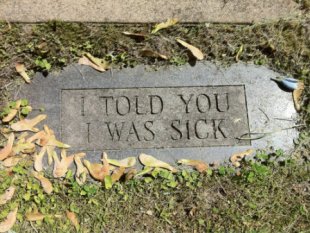
I’m not a hypochondriac.  At least, I don’t think so.

But at 61, I have several chronic conditions (TMJ, upper neck and back pain, anxiety) and then other issues that make guest appearances from time to time (vertigo, extra heart beats, random muscle pain and spasms). I go to the doctor if something seems unusual, or if I suspect they might have some treatment that will improve the chronic ones but other than that, I just try to enjoy the fact that basically, I’m pretty healthy.

However, if several of these symptoms show up at the same time, say vertigo, a restless heart, and a little chest tension, then, of course, my anxiety shoots up and I start getting worried—which makes everything worse.

I’ve had enough false alarms that I’m wary of rushing off too quickly to the doc. I have learned not to call the Kaiser “advise nurse” because no matter how benignly I might describe my symptoms, her solution is always to send me to emergency room hell. I also NEVER Google a symptom. There is no quicker way to be sure that you are dying of some heinous disease, than to plug in a couple of symptoms and let a multitude of websites guess at what you might have.

Because the neck pain drives me crazy, I take ibuprophen every day. I’m confident (because I’ve read the warnings on the side of the extra-large bottle) that eventually my stomach will explode because of it. So when I started to develop a chronic pain on the right side of my abdominal area, I decided to go in to see my doctor. I explained my concerns about the ibuprophen destroying my stomach, and he told me straight out that that was not the issue since my stomach is on the left side. The right side contains the pancreas, liver, and spleen. Great, I thought, now I’ve got three critical organs to worry about.

After reviewing my blood work and doing a physical exam, he told me that he was pretty sure I had something called “abdominal wall pain” which sounded like something that doctors say when they have absolutely no idea what is wrong with you. He reassured me that he had eliminated 95% of the “really bad stuff” and that this diagnosis really did make the most sense. To eliminate the other 5%, he could order up an MRI and blast me with lots of radiation. I decided that I was OK with 95%.

During the exam, though, he introduced me to an interesting bit of doc-speak. He told me that he understood my concerns and my desire for him to be thorough, and that every doctor has to evaluate his patient’s “tolerance for uncertainty” in making a diagnosis. I now know that my “tolerance for uncertainty” is 5% or lower. If I’m 6% uncertain, I’m going to want to full monty of tests, radiation be damned.

However, my tolerance was sorely tested on Christmas Eve this past year. After our usual wonderful meal and as the family celebration was continuing, I excused myself to go to the restroom. Imagine my surprise when I discovered my urine had turned pink. Blood in the urine! This can’t be good. Either my stomach had finally exploded or something was surely wrong with my pancreas, liver, and spleen now that I knew for sure where they were.

I could not rush off to the emergency room on Christmas Eve even if it meant having my kids watch their dad slowly bleed out as we drank beer and watched “A Christmas Story.” I calmly told my wife, and she agreed that I should monitor the situation and as long as I wasn’t in pain, we could get it checked out later. By noon the next day, the symptoms were gone and all that was left was that nagging worry that at any moment, I could go critical again.

I waited until December 26th to go in to see an urgent care doctor and recounted the series of events and my various theories, all of which he kindly discounted. In fact, he seemed intent on assuring me that he was in far worse shape than I appeared to be. He asked me a long series of questions, none of which led to a conclusion. Finally, he paused and asked, “Did you eat anything unusual?”

Beets. Mary had made a beet salad from fresh beets and I ate it to be polite and because I read somewhere that purple food is good for you. I don’t even like beets. No one had ever told me that fresh beets, eaten in large enough quantity, will color everything that passes through your body for about 8-12 hours. Sure, ibuprophen has warning labels, but not beets.

So, am I a worrier—yes. Possessor of a 5% tolerance for uncertainty level—absolutely. Anatomically ignorant—check. Hypochondriac?—Hmmm. Still not sure. I think I’ll wait until the next time I’m nearly killed by a vegetable to decide.